

 Acoustical Ceiling Tiles
Selection and Performance of Vibration Isolation Pads, Mounts and Hangers
DEFLECTION
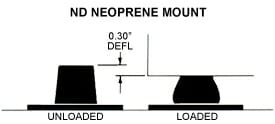
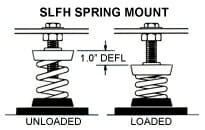
Deflection is the change in flexible elements unloaded to loaded height. It is the deflection that determines how well the vibration isolation works in minimizing typical vibration issues caused by machinery such as compressors. Heavy machinery often generates vibrations when running, and anti-vibration pads can be used to reduce or isolate these vibrations to prevent them from affecting the surrounding environment or structure. More deflection means less vibration transmission. A soft, yielding support is better than a stiff one. There are three classes of vibration isolators based on deflection which are made for different load capacity requirements:
- Vibration isolation pads deflect the least (unless stacked), so they act mostly as noise breaks. They interrupt hard surface-to-surface contact and reduce high frequency vibration.
- Neoprene vibration isolation mounts and vibration isolation hangers deflect more and are the first step in true vibration control.
- Spring isolators have the greatest deflection for maximum vibration reduction.
Product Testing & Information
LOCATION
Sensitive Structural Supports Require Greater Deflections
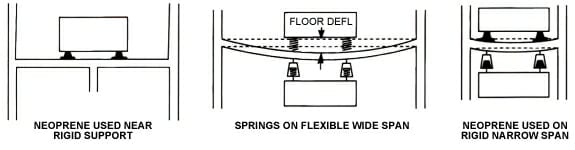
The location of your equipment in the building is the main deciding factor in selecting either neoprene mounts or springs. Neoprene mountings are satisfactory under equipment on a very stiff support structure such as a ground supported concrete slab. On upper building levels where the structure can be very susceptible to vibration, springs are necessary. The key to proper vibration isolator selection in upper levels is to make sure isolator deflection is much greater than floor deflection. If the equipment or heavy machine is running below 1200 rpm, springs are required regardless of location. (The importance of location is the same for isolating suspended equipment.)
SELECTION
Making It Work!
To Select The Proper Isolation For Mechanical Equipment in Most Applications You Need to Ask:
- Is the slowest equipment SPEED ABOVE 1200 rpm? If NO, use spring mountings. If YES, see 2. Vibration from equipment running at slow or variable speeds can pass through low deflection isolators and possibly be amplified by them.
- Is equipment LOCATED on a RIGID concrete building structure or a FLEXIBLE VIBRATION SENSITIVE structure? If RIGID, use tall “double deflection” neoprene or springs If FLEXIBLE, use springs only. The key is to select isolators that are “softer” than the supporting building structure. Ideally isolator deflection should be more than three times greater than the deflection or “sag” of the support.
- What is the equipment’s “corner weight” or weight at each mounting point? The load rating of each spring or rubber mounting must be matched with the portion of the equipment’s weight at the corners or mounting points. Equipment corner weights usually differ and require the use of mountings with different load capacities. Oversized mountings may be used but can reduce vibration control. Select mountings with load capacities equal to or slightly greater than the portion of the equipment weight they are to support.