

 Acoustical Ceiling Tiles
Measuring Acoustic Performance: How Is Sound Quality Determined?
Whether you’re designing a classroom, conference room, recording studio, or restaurant, measuring acoustic performance is about answering one question: does the space support the way it’s meant to be used? Good acoustics aren’t defined by a single score or measurement. A room that sounds excellent for live music may create too much reverberation for a lecture, while a quiet office designed for speech privacy may feel unnaturally “dead” in another setting.
Acoustics professionals decide how sound quality is determined by combining objective measurements with how people experience the space. They evaluate how sound reflects, travels between rooms, and affects speech clarity, then compare those results against the room’s intended purpose. Instead of relying on one universal rating, they use several acoustic performance measurements to identify what is working, what is not, and which improvements will have the greatest impact.
What Does Acoustic Performance Mean?
Acoustic performance describes how effectively a room or building supports its intended function. In some spaces, that means making every spoken word easy to understand. In others, it means preserving musical detail, reducing distracting background noise, or preventing conversations from carrying into neighboring rooms.
This is why there is no single definition of “good sound.” A classroom, recording studio, restaurant, auditorium, and private office all have different priorities, so their room acoustics should be evaluated differently. Different spaces require different acoustic conditions.
How Is Sound Quality Determined?
Professionals determine how to measure sound quality by evaluating several characteristics of a space. They evaluate how loud the environment is, how long sound remains after it is produced, how evenly different frequencies are reproduced, how understandable speech is, and how much unwanted sound enters or leaves the room. Together, these room acoustic measurements provide a more complete picture of performance than any one rating can on its own.
The measurements that matter most depend on the problem being solved. Excessive echo points to different issues than poor speech clarity or sound leaking through a wall, which is why acoustic testing focuses on the metrics that best match the room’s intended use.
| Measurement | What It Measures | What It Helps Determine |
| RT60 | How long sound takes to decay | Reverberation and room liveliness |
| Sound Pressure Level (SPL) | Overall sound level | Loudness and background noise |
| Frequency Response | Sound energy across frequencies | Tonal balance and problem frequencies |
| Speech Transmission Index (STI) | Speech transmission quality | Speech intelligibility |
| Noise Reduction Coefficient (NRC) | Material sound absorption | How absorptive a product is |
| Sound Transmission Class (STC) | Airborne sound isolation | How well an assembly blocks sound |
| Impact Insulation Class (IIC) | Impact sound isolation | Floor and ceiling impact-noise control |
With these measurements in mind, we can look at what each one tells us, when it matters, and how professionals use the results to improve a room’s acoustic performance.
Reverberation Time (RT60): How Long Does Sound Linger?
One of the first things acoustical professionals evaluate is reverberation time – often called an RT60 measurement. RT60 is the time it takes for sound to decrease by 60 decibels after the source stops. In simple terms, it measures how long sound continues to linger in a room.
This measurement has a direct impact on how a space feels. When reverberation is too long, conversations begin to overlap, speech becomes harder to follow, and the room may sound echoey or fatiguing. When it’s too short, music and performances can lose their sense of warmth and natural ambience.
There is no single “correct” RT60 value because every room has different goals. A classroom typically benefits from shorter reverberation than a concert hall. Lower isn’t always better. The right RT60 depends on the room’s intended use.

Sound Pressure Level: How Loud Is the Space?
While RT60 measures how long sound lasts, sound pressure level measures how loud the environment is. An SPL measurement expresses sound level in decibels (dB), capturing both the sounds people want to hear and the background noise they would rather avoid.
Even a room with well-controlled reverberation can feel uncomfortable if HVAC equipment, nearby traffic, machinery, or conversations keep the overall noise level too high. Excessive background noise reduces speech clarity and increases listening fatigue.
Because sound levels influence nearly every aspect of room performance, professionals use calibrated sound level meters to measure existing conditions before deciding whether noise reduction or other acoustic improvements are needed.
Frequency Response: Is Sound Balanced Across Frequencies?
Not all sound behaves the same way across the frequency spectrum. Two rooms can produce nearly identical decibel readings while sounding noticeably different because certain frequencies are emphasized or suppressed. This is why professionals also evaluate frequency response.
By examining sound energy across octave or one-third-octave bands, acoustical consultants can identify specific problem areas, such as excessive low-frequency buildup, harsh high-frequency reflections, or missing midrange clarity.
Frequency analysis helps explain why a room sounds the way it does, making it easier to select treatments that address the actual problem instead of relying on a single averaged measurement.

Speech Intelligibility: Can People Understand What Is Being Said?
Some spaces are judged less by how they sound than by how well people can communicate within them. In those environments, speech intelligibility often matters more than any other acoustic measurement.
Speech can become difficult to understand even when voices are loud enough. Excessive reverberation, background noise, long listening distances, and poor sound system performance can all reduce clarity. To evaluate this objectively, professionals often use the Speech Transmission Index, commonly referred to in STI acoustics. Rather than measuring loudness, STI evaluates how clearly speech can be transmitted and understood within a room.
Speech intelligibility is especially important in spaces where understanding spoken communication is essential. When RT60, background noise, and other acoustic conditions are properly controlled, speech naturally becomes clearer and easier to follow.
NRC: How Is Sound Absorption Measured?
The measurements we’ve covered so far describe how sound behaves within a room. Noise Reduction Coefficient (NRC) measures something different: how much sound a material absorbs instead of reflecting back into the space.
An NRC rating is a single-number value calculated from a material’s acoustic absorption coefficient at 250, 500, 1,000, and 2,000 Hz. It gives architects and designers a consistent way to compare different types of absorptive products.
What an NRC rating does not tell you is how good a room will sound after that product is installed. A material with a high NRC can reduce reflected sound, but room size, layout, placement, and the amount of absorptive treatment all influence the final result. The rating describes the product’s performance under standardized test conditions, not the acoustic performance of an entire space.
NRC helps compare materials, while measurements like RT60 reveal how those materials affect the room once they’re installed.
STC: How Is Sound Isolation Measured?
Sound Transmission Class (STC) addresses sound traveling between rooms. An STC rating compares how well a wall, floor, ceiling, door, or other building assembly reduces airborne sound transmission.
This makes STC valuable for spaces where privacy or noise control extends beyond a single room. Offices, healthcare facilities, and hotels often rely on higher STC assemblies to reduce conversations, television noise, or other airborne sounds passing through partitions.
Like NRC, STC has limits. Laboratory ratings measure the performance of a tested assembly under controlled conditions. In real buildings, gaps around doors, ductwork, electrical penetrations, and other flanking paths can reduce overall sound isolation measurement performance.
A room with excellent sound absorption can still allow conversations to pass through walls, just as a well-isolated room can still suffer from excessive reverberation. NRC and STC measure different aspects of acoustic performance, so both may be needed to understand how a space will perform.
What About Impact Noise and IIC?
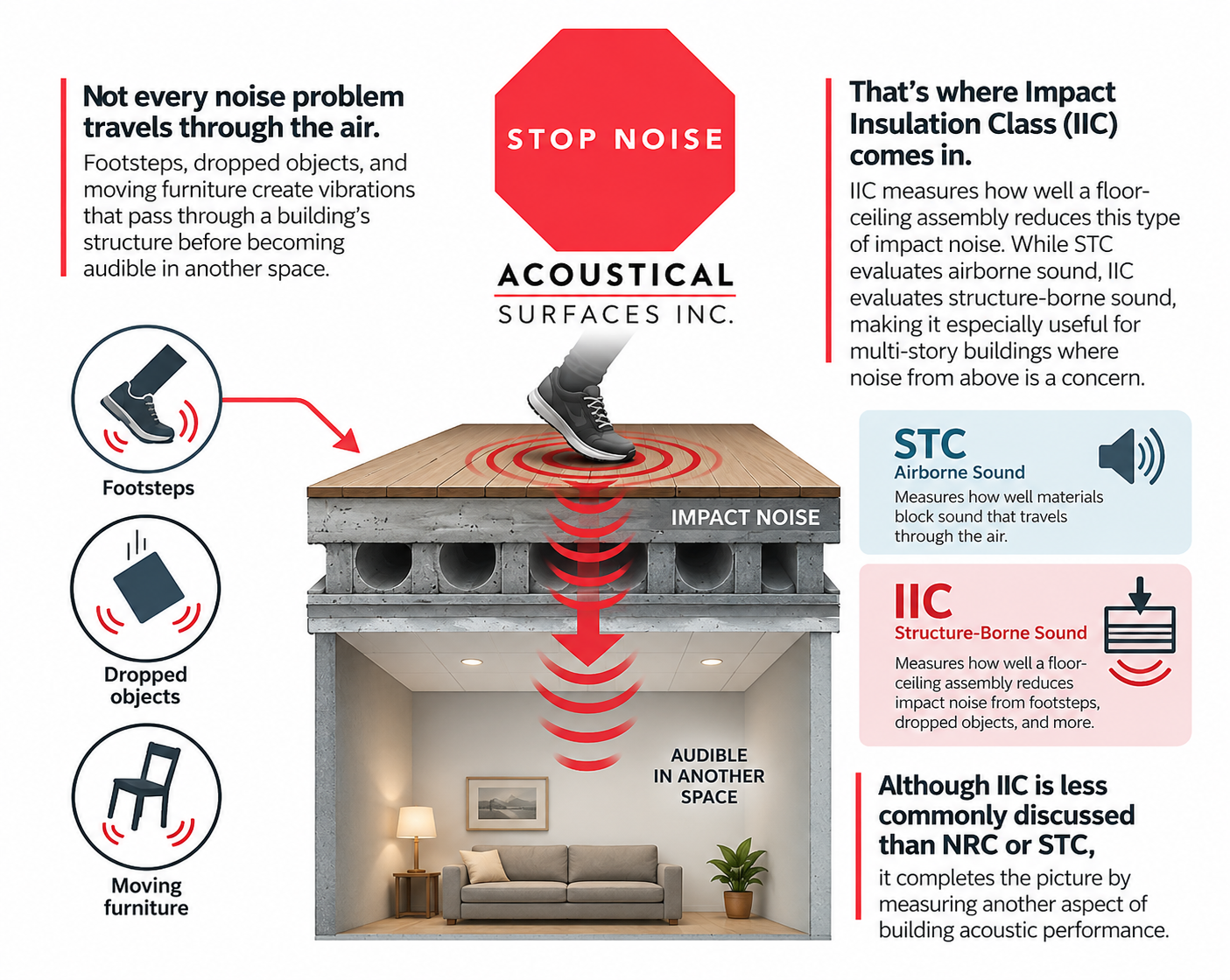
Not every noise problem travels through the air. Footsteps, dropped objects, and moving furniture create vibrations that pass through a building’s structure before becoming audible in another space.
That’s where Impact Insulation Class (IIC) comes in. IIC measures how well a floor-ceiling assembly reduces this type of impact noise. While STC evaluates airborne sound, IIC evaluates structure-borne sound, making it especially useful for multi-story buildings where noise from above is a concern.
Although IIC is less commonly discussed than NRC or STC, it completes the picture by measuring another aspect of building acoustic performance.
How Is Acoustic Performance Measured in a Room?
Understanding the measurements is only the beginning. Applying them in a logical order leads to effective solutions instead of guesswork.
Step 1: Define What the Room Needs to Do
Every assessment starts with the intended use of the space. A classroom may prioritize clear speech, a restaurant may need better reverberation control, and a conference room may focus on speech privacy. Identifying that objective first determines which measurement deserves the most attention.
Step 2: Take Baseline Measurements
Professionals then collect the measurements that match the problem. Depending on the space, that may include SPL, RT60, frequency response, or STI. Measurements are taken with calibrated equipment from multiple locations to accurately assess the room.
Step 3: Identify the Source of the Problem
The measurements reveal where the problem actually comes from. Excessive reflections, outside noise, sound leakage, mechanical equipment, or uneven frequency balance can produce similar complaints while requiring very different solutions.
Step 4: Apply the Appropriate Acoustic Solution
Once the source is known, treatments can be matched to the measurements. Excessive reverberation may call for additional absorption. Uneven reflections may benefit from a combination of absorption and diffusion. Poor sound isolation may require improvements to the building assembly instead of simply adding acoustic panels. If you’re unsure which approach your project requires, learn more about the differences between soundproofing and sound absorbing materials.
Step 5: Measure Again
The final step is confirming the results. Comparing before-and-after measurements shows whether the treatment solved the original problem and whether the room now performs as intended. Successful projects aren’t judged by the number of panels installed – they’re judged by measurable improvement.
Why Room Type Changes What “Good Sound” Means
The same measurements can lead to different design decisions because rooms are designed for different purposes. A classroom depends on clear speech, while a recording studio needs balanced reflection and accurate frequency response. A restaurant may tolerate more background noise than a conference room, and a performance venue often benefits from more reverberation than an office.
Instead of chasing the lowest RT60 or the highest NRC, professionals evaluate whether the measurements support the way the space will actually be used. Acoustic performance is measured against the room’s purpose – not against a universal standard.
| Room Type | Primary Acoustic Goal | Measurements to Prioritize |
| Classroom | Clear speech | RT60, STI, SPL |
| Restaurant | Control reverberation and noise | RT60, SPL |
| Recording Studio | Balanced sound reproduction | Frequency Response, RT60 |
| Office | Speech privacy and low distractions | STC, STI, SPL |
| Auditorium | Speech and music quality | RT60, STI, Frequency Response |
How Acoustic Treatments Improve Measured Performance
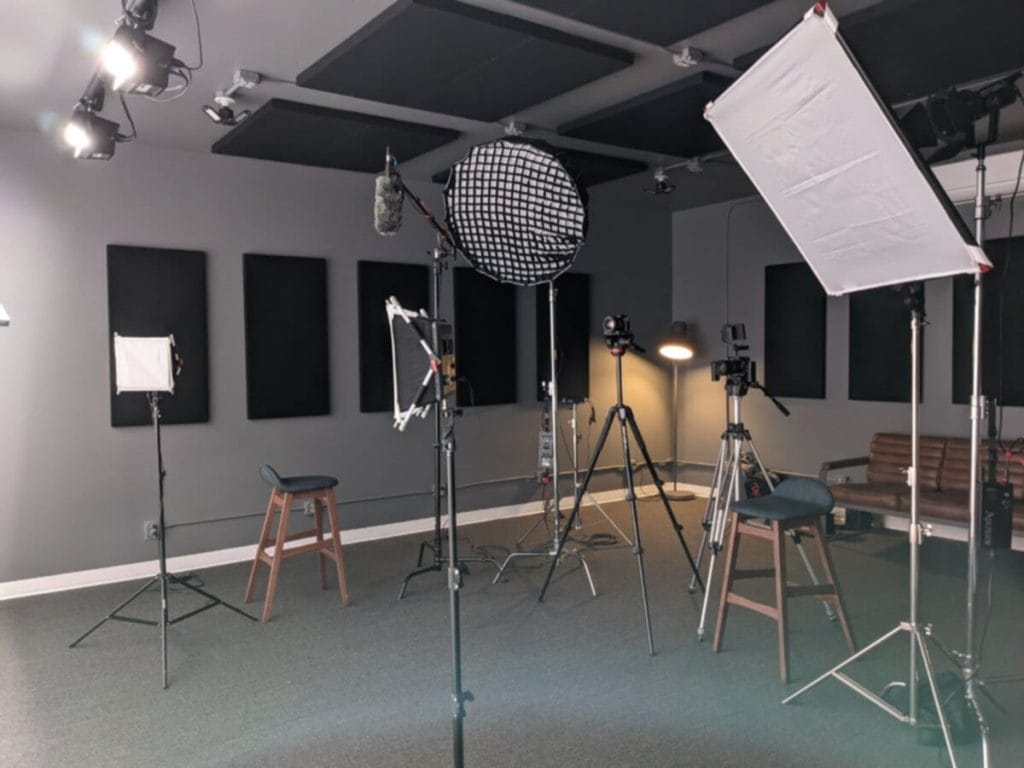
Measurements identify the problem before products are selected. If RT60 is too long, absorptive wall panels, ceiling treatments, baffles, or clouds can reduce reflected sound and shorten reverberation. If unwanted noise is passing through walls or ceilings, improving the building assembly will be more effective than adding sound-absorbing panels.
Matching the treatment to the measurement produces more predictable results than relying on a one-size-fits-all solution.
How to Read Acoustic Product Test Data
Acoustic product specifications are most useful when you understand what was actually tested. Some ratings describe sound absorption, while others measure sound isolation or impact noise. A high NRC doesn’t imply a high STC, and a high STC doesn’t indicate how much sound a material will absorb inside a room.
Look for products backed by independent laboratory testing and verify the published data matches the performance you’re trying to improve. Acoustical Surfaces publishes independently tested sound and flammability data for its sound-absorbing and soundproofing products, making it easier to compare products based on measured performance.
Read More: Acoustic Testing Basics: What It Is, Why It Matters, and How to Get Started
Can You Measure Sound Quality Yourself?
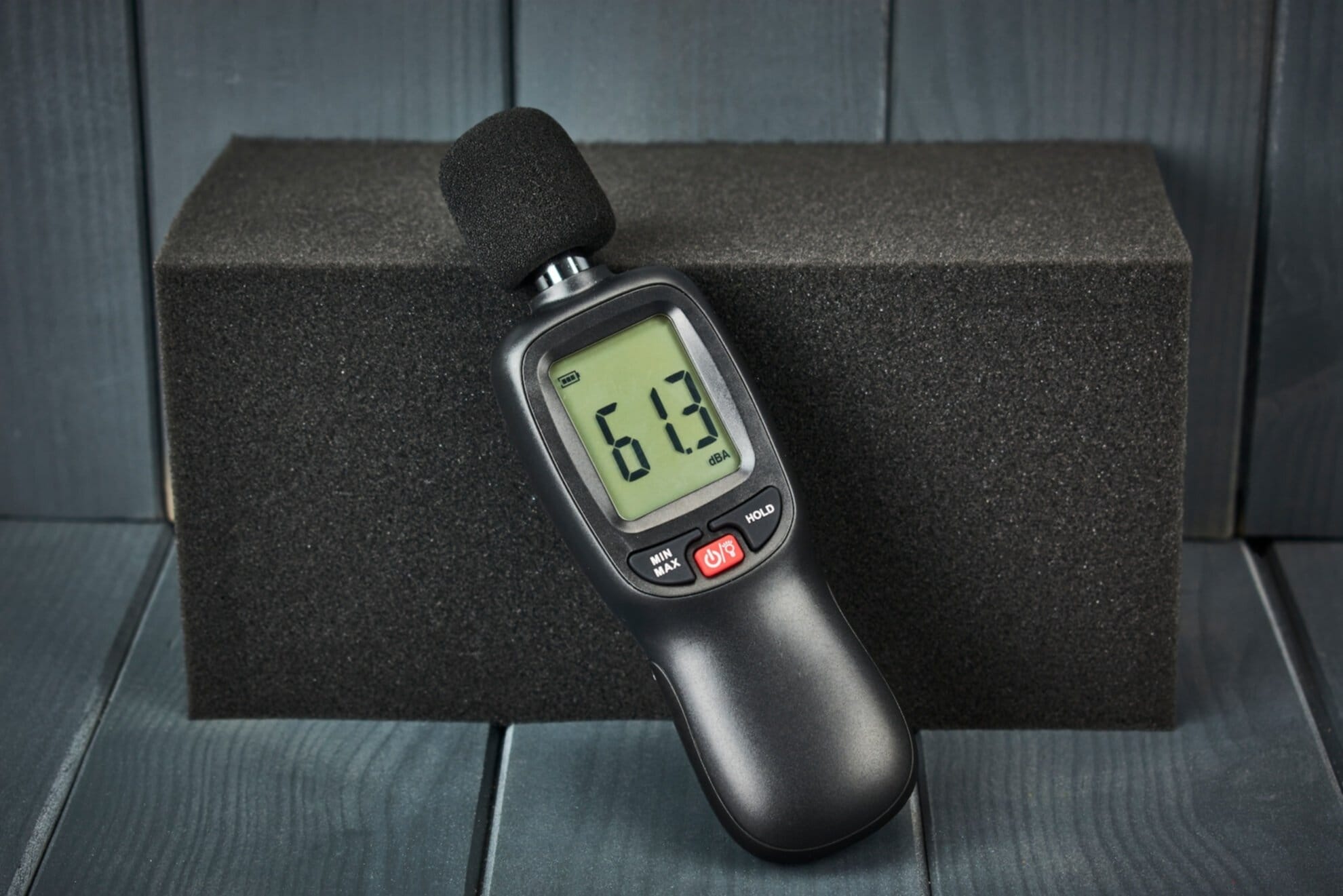
A sound level app or a simple clap test can help reveal obvious acoustic issues, but they only provide a starting point. Professional assessments use calibrated instruments, measurement microphones, room-analysis software, and standardized testing procedures to produce reliable results.
For projects involving building design, code requirements, performance spaces, or persistent acoustic problems, professional testing provides the information needed to choose the right solution.
Measuring Acoustic Performance: The Bottom Line
Measuring acoustic performance begins with understanding how a space is meant to function. No single measurement can determine sound quality on its own. RT60, SPL, frequency response, and STI reveal how a room behaves, while NRC, STC, and IIC measure specific characteristics of materials and building assemblies.
The most effective acoustic improvements come from matching the right measurement to the right problem before choosing a solution, and objective measurements provide the information needed to make confident decisions.
Acoustical Surfaces offers independently tested sound absorption, sound isolation, and noise-control solutions to help architects, designers, facility managers, and building owners create spaces that perform as intended. Whether you’re designing a new facility or improving an existing one, measuring acoustic performance first helps you choose products that address the right problem and deliver lasting results.