

 Acoustical Ceiling Tiles
How to Deaden Sound in a Counseling or Psychologist’s Office
Confidential conversations deserve rooms that feel calm, controlled, and truly private. In therapy environments – whether a counseling office, psychologist’s suite, or multidisciplinary practice – office sound deadening isn’t just a nice-to-have. It’s part of creating trust, complying with HIPAA, and preventing voices from leaking into hallways or adjacent rooms. When clinicians and patients know the room won’t betray their words, the work becomes easier, and the space feels grounded instead of tense.
What most people call “deadening” a room actually involves two parallel goals:
- Sound isolation – keeping voices from traveling through walls, ceilings, duct work, corridors, or doors.
- In-room acoustic treatment – reducing reflections, echo, and excessive loudness within the office so conversations feel intimate rather than “bright” or fatiguing.
This guide breaks down both sides of the solution, using practical, commercial-friendly methods for remodels, new builds, or quick improvements on weekends. We even include a quick bill of materials for various goals at the end. Whether you’re addressing therapy office acoustics, fixing a noisy waiting room, or planning an office soundproofing remodel, these steps give you a reliable blueprint.

1. Set the Target (What “Good” Sounds Like)
Clinicians often describe ideal therapy rooms as soft, calming, or contained. From an acoustics standpoint, that means two things: controlled sound inside the room and limited sound escaping it.
Inside the Therapist’s Office: A Pleasantly Quiet Space
If you clap your hands and hear a flutter, “ring,” or lingering tail, the room’s reverberation time (RT60) is too long for counseling work. A healthy target for small offices is roughly 0.3-0.5 seconds, which corresponds to speech that feels close and personal.
For non-technical readers, the easiest explanation is this:
Good counseling rooms don’t feel echoey. Voices should stop quickly so the conversation stays intimate, not amplified.
Getting to this level of reverberation (or lack thereof) generally requires adding absorptive acoustical panels and can be supplemented with soft surfaces like furniture, thick rugs and other absorptive surfaces like thick draperies or window treatments.
Outside the Room: Intelligibility Should Drop to Zero
From the corridor, you should hear muffled activity at most – not individual words. Achieving this goal relies on:
- A wall/ceiling/door assembly with a respectable STC rating
- Sealed penetrations and flanking path avoidance
- Optional corridor sound masking (white noise) to wash away the last traces of leaked syllables
When speech privacy is the goal, these three elements work together. Even a high-STC wall won’t perform properly if the door leaks or the ceiling tile system forms an acoustic shortcut. In multi-story buildings, it also helps to check the floor/ceiling assembly’s IIC rating, since impact noise from above can distract clients during sessions.
2. Fast Wins You Can Do This Week (Remodel-Friendly)
If you need improvement quickly – without opening walls for full room soundproofing – these upgrades give significant return on investment. Most can be done over a weekend by local contractors or even by business owners with a little DIY knowledge.
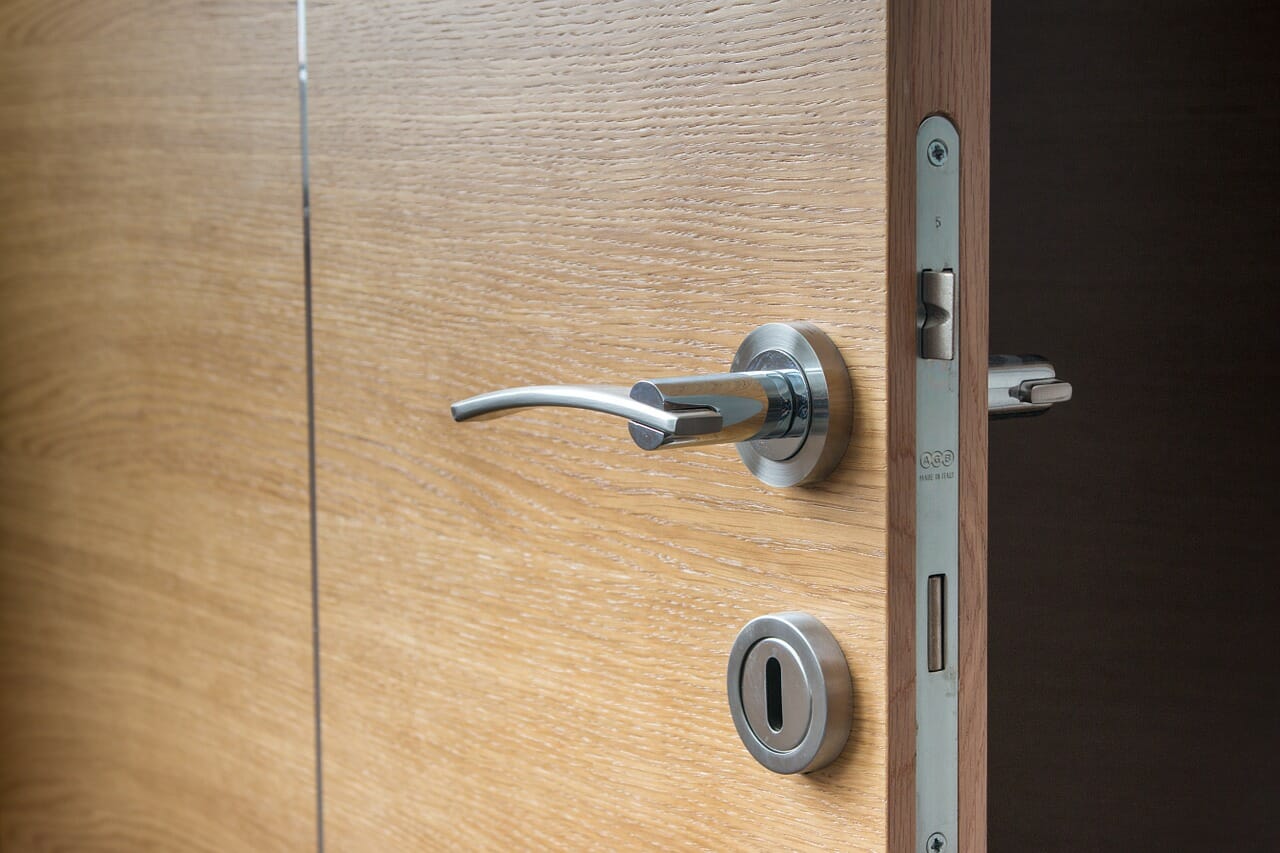
Seal the Door ( the #1 Privacy Killer)
A typical hollow office door performs poorly, but even a solid-core door will leak sound if its edges aren’t sealed. In these cases, add:
- A perimeter door seal kit (which includes gasket seals for the entire perimeter of the door)
- An automatic door bottom (if the sides and top of the door are gasketed with something like a simple weather stripping)
- Visually inspect for light gaps around the door frame and/or door trim. If not completely sealed, remove the door trim and add a bead of (non-hardening) acoustic caulk between the door frame and rough opening or drywall (non-hardening) to keep noise contained.
Even without replacing the door itself, sealing air gaps can dramatically improve a therapist office confidentiality.
Seal the Room’s Weak Spots
This is another spot where acoustic caulk / sealant can be extremely valuable. In addition to door frames, use it along wall-to-ceiling and wall-to-floor joints where any visual or audible gaps are present, gaps at or behind window trim, junction boxes (using putty pads on the back side if accessible), penetrations for pipes, data ports, and conduits, and anywhere visible or audible gaps or cracks are present. These measures limit flanking paths – hidden routes through which sound escapes even when the wall itself is fine.
Add Absorption Where it Counts
To address in-room echo, reverberation, or reflections and improve speech intelligibility, the quickest method is adding an appropriate amount of absorptive surface area into the space. Using acoustic panels for small offices helps reduce reverberation without overwhelming the visual design. Panels can be wall-mounted or ceiling-mounted, as they will offer the same amount of reduction regardless of installation location. If your small office is equipped with a sprinkler system, ceiling clouds aren’t always an option, but surface-mounted ceiling absorbers can be installed and will work very well to take the edge off of the room. Using products with NRC rating at or above 0.80 helps ensure the panels actually absorb the frequencies most relevant to speech.
Absorption rules of thumb that work well in counseling offices:
- More is better than less. Adding as many square feet as possible in these types of spaces is usually a good practice.
- When in doubt, determine the cubic volume of the space (height x width x depth). Multiply this number by .06 (6%) which will provide you with a target square footage of panels to add to the room. Once this is installed, step back and listen. You can always fine tune afterward, if needed. Remember, for overall reverberation reduction, this square footage can be installed anywhere in the room and have generally the same impact.
Quiet the Plenum
In offices with a lay-in grid, the space above the ceiling – the plenum space – often leaks sound between rooms. Solutions include:
- Replace standard tiles with barrier-backed ceiling tiles or cut drywall to ceiling tile sizes and lay drywall on the back of the existing tiles.
- Seal visible gaps around the grid perimeters
- Ensure the common wall extends to the deck if possible
Tame Noisy Ducts
Short, direct duct runs can produce audible “hiss” or transmit room-to-room sound. Lining them with an absorptive acoustical liner on the inside of the duct or wrapping them with pipe noise lagging reduces both HVAC noise and breakout noise.
Add Optional Sound Masking
Low-level sound masking devices installed in corridors or waiting rooms can hide any remaining sound leakage. It’s not a substitute for structural isolation, but it is helpful with privacy issues.
3. Making the Office Pleasantly “Dead,” Not Dull
A well-treated therapy office should feel quiet, but not padded or lifeless. Over-absorbing a room can make it feel unnatural, so balance is important.
Coverage and Placement Based on Room Geometry
There’s no universal “2-4 panel” fix for these types of spaces – how well a room behaves depends on its size, the furnishings or other soft surfaces in the room, and how close people are to reflective surfaces. In most counseling offices, it is generally a good idea to spread absorption across the main hard surfaces rather than clustering panels on one wall. Ceilings in these spaces are usually too low for acoustic clouds, and sprinkler layouts often rule them out anyway, though surface-mounted ceiling panels can help in trouble spots.
Material Choices That Look Professional
Clients spend a great deal of time looking around the office, so practical choices should also look polished, intentional and professional. Here are some materials that balance form and function beautifully:
- Fabric-wrapped absorbers – the standard for counseling environments; custom made to size and shape, thousands of fabric color options to choose from, visually professional, clean, and easily installed.
- Felt/PET panels – Economical, professional and clean aesthetic, modern, plus easy to install.
- Micro-perforated metal over absorptive core – ideal for healthcare spaces requiring high cleanability.
- Printed absorbers – Covering absorptive cores with custom printed yet acoustically invisible fabric can create calming or visually appealing artwork, branding elements, or nature imagery that doubles as acoustic treatment.
Blend Absorption and Diffusion
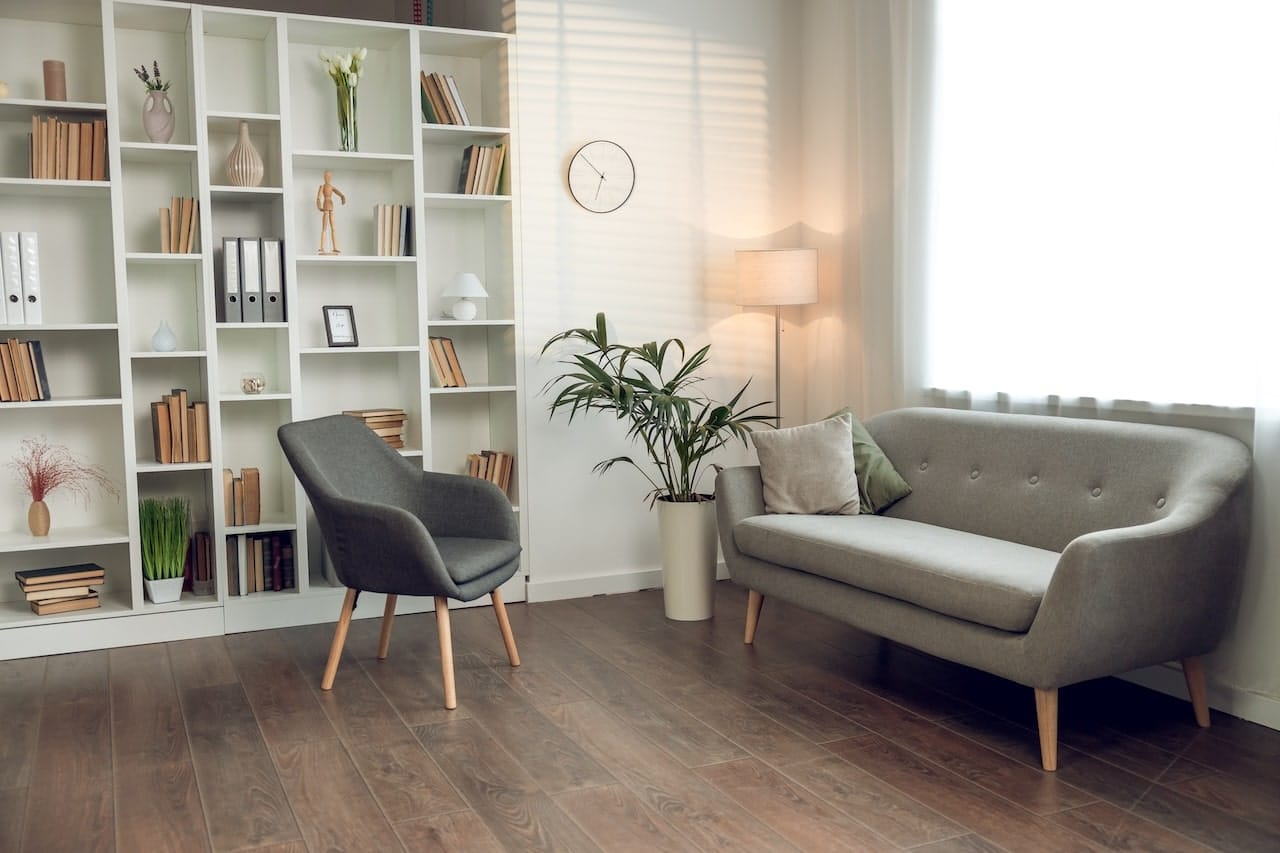
Too much absorption can create an unnatural acoustic experience. Adding mild scattering – such as bookcases with varied objects or shallow acoustic diffusers – keeps the space sounding warm and balanced.
4. When You Need More Deadening Between Rooms
There are times when fast fixes – door seals, added absorption, plenum/duct work – still don’t bring speech levels down enough for true therapist office confidentiality. In those cases the issue is potentially the wall itself. Some counseling offices are built with lightweight partitions that simply don’t have the mass, damping, or structural separation required to stop human speech. When isolation needs to improve meaningfully, the solution usually involves adding mass, damping the wall assembly, and/or reducing the physical connection between rooms.
A common first step is increasing mass by installing a new, additional layer of ⅝” drywall over the existing wall. On its own, this adds a few dB of isolation, but the real improvement happens when a viscoelastic damping compound – Green Glue being the best-known example – is applied between the layers. This compound dissipates vibrational energy, allowing the new surface to perform far better than its thickness would suggest.
- Adding mass improves the STC rating of the wall.
- Adding damping reduces the efficiency with which sound vibrations pass through the assembly.
- Sealing the perimeter with acoustic caulk prevents flanking leaks that would otherwise undo the benefit.
When more performance is needed and one side of the wall can be opened, decoupling is the next upgrade. Using resilient sound isolation clips and hat channel decoupling, you create an air gap and a flexible interface between the studs and the new drywall layer. This dramatically reduces the amount of energy that can vibrate through the structure.
In many therapy offices, the wall isn’t the only weak link. Flanking paths through the plenum space, electrical boxes, shared ductwork, or lightweight ceiling tiles can undo the improvements made in the main partition. Bringing the ceiling up to the same standard – with barrier-backed tiles or a sealed gypsum lid – and relocating or using putty pads on the back of electrical boxes helps the wall perform as designed.
By combining mass, damping, and flanking-path control, you end up with a counseling office that finally behaves the way clinicians expect: quieter inside, quiet outside and not dependent on whispering to maintain privacy.
5. Hallway Strategy (Because Confidentiality Fails Outside the Door)
Even if a therapy room is well-isolated, the hallway outside the door plays a major role in how much privacy a client feels. Corridors are often long, reflective spaces where sound leaking out of treatment rooms can be amplified from the echo and reverberation. This is why addressing the corridor is just as important as treating the counseling room or an adjacent office.
A surprisingly effective solution is corridor sound masking – a controlled, barely noticeable broadband signal that fills what would otherwise be a silent space. In a waiting room or main hallway, this gentle sound provides a stable background floor, which makes residual speech energy far less intelligible. Masking doesn’t make things louder; it makes speech less contrastive.
Soft finishes help too. Upholstered seating, carpet runners, and a few absorptive accents reduce reflections and shorten the hallway’s reverberation time. When the corridor stops acting like a reflective tunnel, any leaked speech dissipates before it becomes recognizable.
6. Three Ready-to-Spec Bundles
Because every counseling practice has different needs, it helps to think about acoustic upgrades in three performance tiers. These are not rigid packages – they’re starting points based on common challenges in small offices, private practices, and larger healthcare settings.
Good: The Practical Retrofit
This tier is ideal when the existing construction is reasonable, but the room suffers from door leaks and excessive reflections.
- Replacing hollow core with heavier solid core doors and adding high-quality door seal kits with automatic door bottoms
- Adding enough absorption to appropriately control reverberation and improve speech intelligibility
- Installing acoustic caulk and putty pads to treat the most common flanking points
- Adding localized sound masking to cover the last traces of leakage
It’s a simple path that brings noticeable improvement with minimal disruption.
Better: A meaningfully Quieter Office
The next level adds structural improvements for spaces that need stronger separation between rooms but still want to avoid major reconstruction.
- Adding a second layer of ⅝” drywall and Green Glue on one or both sides of the shared walls
- Installing barrier-backed ceiling tiles above the office
- Installing absorptive duct lining or pipe noise lagging on short duct runs to remove hiss and breakout noise
For the majority of counseling practices, this level delivers the comfort and privacy clinicians associate with a professionally engineered space.
Best: Near-Studio Privacy
Some practices need the acoustic equivalent of a sealed envelope – particularly psychologists conducting evaluations, high-stakes interviews, or trauma-focused work. Here, the wall and ceiling systems are treated as a coordinated assembly.
- Using RSIC-1 resilient clips and hat channel decoupling the wall assembly
- A high performance STC rated door assembly like the Studio 3D door.
- Double ⅝” drywall with damping (Green Glue) on both sides
- A sealed gypsum lid
- Fully sealed penetrations, treated outlets, and an upgraded door system
- Treated HVAC duct work on all supply and return runs to and from the room
- Corridor masking to finish the speech-privacy envelope
This level approaches studio-grade isolation while fitting into standard commercial construction.
Chat with Acoustic Experts
Great therapy environments depend on controlled acoustics – inside the room and outside it. By combining proper isolation, balanced room acoustic treatment, and smart corridor strategy, you can create a counseling space that feels secure, warm, and confidential.
If you’re planning improvements, a remodel, or a new build, Acoustical Surfaces can help you navigate the right materials – from mass loaded vinyl and damping compounds to absorptive finishes and soundproof doors. Reach out to one of our team members today to discuss solutions tailored to your space and ensure your approach to office sound deadening is as effective and reliable as the care you provide.