

 Acoustical Ceiling Tiles
The Benefits of Commercial Soundproofing
Over the past 5-10 years, noise has become one of the biggest occupant comfort issues in modern facilities – offices, schools, hotels, healthcare wings, retail, mixed-use buildings, and even industrial campuses. As employers rethink spaces with the rise of hybrid and remote work, acoustic comfort is now treated as a measurable quality-of-life metric for those returning to the office rather than a “nice-to-have.” For businesses looking to keep employees productive and guests comfortable, the commercial soundproofing benefits available today are both more accessible and more effective than most stakeholders expect.
Effective commercial soundproofing turns chaotic, fatiguing environments into places where work gets done, conversations remain private, and customer experiences feel polished. The key is knowing where to invest early, how to diagnose weak points during remodels, and how to balance isolation (blocking noise) with acoustical treatment (making the room itself sound better).
Below is a business-first guide to the most important surfaces, assemblies, and products to consider – plus realistic expectations around glass, coordination requirements during construction, and the acoustic shortfalls that can catch even seasoned builders by surprise.
Why Soundproofing Your Facility Pays Off
Productivity & Guest Experience
For educators, hospitality teams, medical staff, and customer-facing employees, noise is more than an annoyance: it’s an efficiency killer. When conversations bleed between rooms, speech intelligibility drops and everyone spends more energy trying to focus. Offices get louder as people raise their voices to compensate, and classrooms or hospitality venues quickly become noticeably less comfortable.
Well-designed assemblies with higher STC ratings, proper seals, dampened drywall layers, and resilient mounting hardware help prevent sound transmission from room to room. The result is fewer distractions for staff and a calmer, more premium guest experience – whether it’s a hotel corridor, coworking suite, or a university concourse.
Acoustic Comfort Inside the Room
Isolation only solves half the problem. To make a room pleasant to work or meet in, you need to control reflections so speech feels clear and steady. That usually means pairing your isolation strategy with well-placed absorptive panels of diffusers. In commercial interiors like classrooms, conference rooms, and hospitality spaces, owners often rely on cleanable wall panels, perforated metal or vinyl ceiling tiles, or polymer-based panel options like Sound Silencer or Poly Max to bring reverb down to a comfortable level. It is important to choose the right material based on the needs of your space as well as making sure that the chosen product has the right NRC rating for the room’s purpose and use.
Privacy & Professionalism
Speech privacy is one of the most tangible returns on commercial soundproofing, especially in H.R. suites, clinics, and meeting rooms where conversations need to remain contained. Strong performance comes from treating the wall assembly, installing doors with the appropriate STC rating, and being sure to not overlook room weaknesses like common HVAC vents/ducts and potentially leaky standard ceiling tiles.
This is also the point in a project where documentation carries real weight. The acoustic intent should spell out how the wall is built – typically a combination of mass, damping, and decoupling using resilient sound isolation clips – so field crews understand the expected assembly. It should also note exactly where sealants and damping layers belong, such as Green Glue between gypsum layers and acoustical sealant at all perimeter joints. Just as important is explaining how flanking paths are being closed, whether that involves a plenum strategy, careful electrical box placement, or treated penetrations.
Clear, early direction prevents guesswork on site, protects the performance you’re paying for, and helps ensure that privacy-critical spaces actually deliver the level of professionalism occupants expect.
What Surfaces to Consider in Commercial Soundproofing
Every building has three main “gateways” where noise tends to slip through: the vertical surfaces (walls), the horizontal surfaces (floors and ceilings), and the openings that interrupt them (outlets, vents, and MEP penetrations). Addressing these surfaces systematically is what separates guesswork from reliable commercial soundproofing. The aim is to create assemblies that work as a system – solid, sealed, and predictable – rather than a patchwork of isolated fixes.
Once you understand how sound travels through mass, vibration, and air gaps, the path forward becomes clearer. You can strengthen each surface in a way that not only reduces noise transfer but also complements the rest of the build.
Walls & Ceilings
Walls and ceilings usually carry the bulk of airborne sound, and the classic recipe – mass, damping, and decoupling – remains the most dependable approach. Instead of treating these as abstract techniques, think of them as three levers that work together. Mass slows the energy, damping converts vibration into heat, and decoupling prevents the structure from transmitting the sound energy from one side of a wall to the other via hard-surface connection points.
Most commercial assemblies start by separating the finish layer from the framing with resilient sound isolation clips, applying a viscoelastic damping compound like Green Glue soundproofing compound over the drywall, and adding a second layer of ⅝” gypsum over the top. When all three are used together, you will see meaningful and substantial improvements in the STC rating.
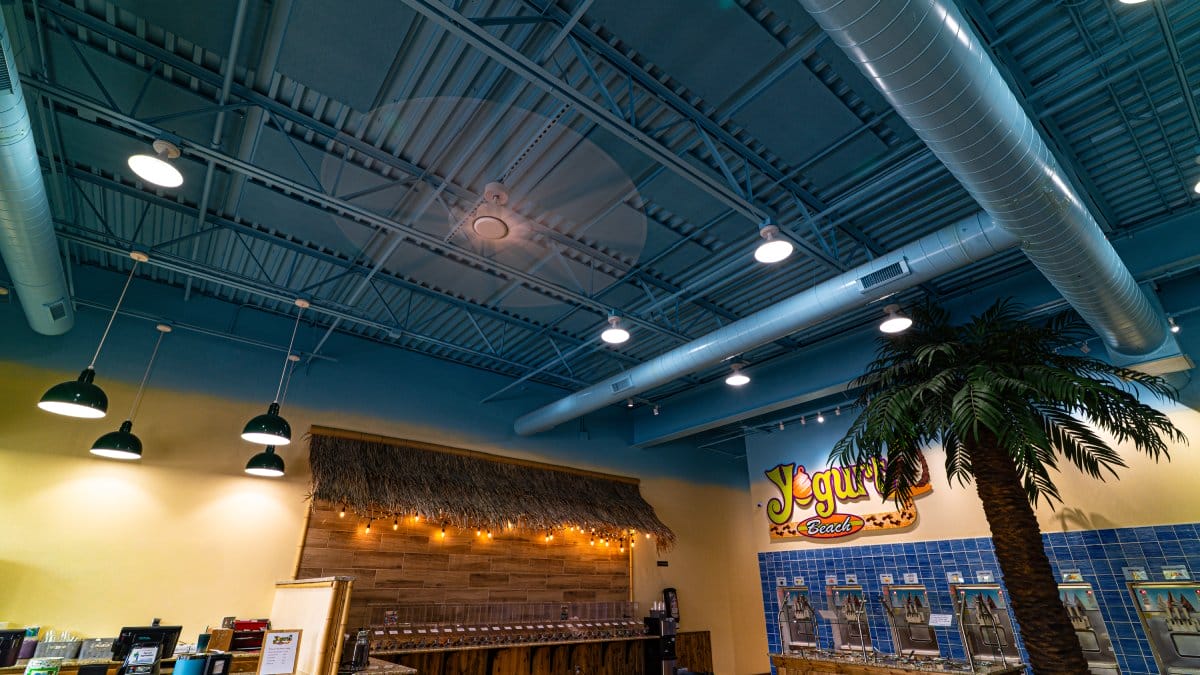
Ceilings introduce one extra wrinkle: the open plenum. If sound can jump over the wall through lightweight tiles, even a great wall assembly suffers. In these cases, solutions like sound barrier ceiling tiles, composite panels with a built-in sound barrier with a decoupler, or a sealed gypsum lid help restore continuity and reduce ceiling plenum leakage.
You can also strengthen wall or lid performance by incorporating dense, flexible barriers like mass loaded vinyl (MLV) within your sound isolation assemblies. MLV adds broadband blocking without adding excessive thickness, which is useful in high-traffic areas or common wall assemblies where you have access to the studs on at least one side. In suspended-grid spaces, drop ceiling soundproofing often means pairing heavier barrier tiles with a sealed lid or plenum treatments so the ceiling no longer acts as an open bypass. These enhancements don’t replace the mass-damping-decoupling recipe, but they do help assemblies behave more predictably in real-world conditions where multiple surfaces interact.
Floor Soundproofing for Airborne Noise
Floors often get overlooked until someone drops a phone or a guest complains about the thudding from the room above. Footfall noise travels as vibration through the structure, and even modest improvements can make multi-story buildings feel dramatically calmer. Thin, rigid floor finishes like tile and hardwood benefit the most from a purpose-built floor underlayment, which cushions impact while reducing airborne transfer into the rooms below.
Where airborne noise between levels is a concern, combining a dense underlayment with strategic ceiling treatments below provides a balanced solution. It’s a simple way to control impacts, voices, and mechanical noise without a major reconstruction.
When diagnosing floor issues, it helps to separate airborne vs impact noise, since each behaves differently in lightweight structures. Impact performance is usually tracked through an IIC rating, while airborne performance aligns more closely with STC. Small details matter here too: transitions, floor plates, and even incorrect underlayment placement can reopen vibration paths. Adding rubber gasket tape below plates or under certain finishes helps prevent hard coupling and keeps impact noise from jumping into adjacent spaces.
Doors: The Biggest Holes
Even the best wall assembly can fail at the door. Because doors move, rely on clearances, and often lack compression seals, they’re usually the largest weak point in an otherwise solid design. The good news is that fixing a door is one of the fastest upgrades you can make.
Reliable setups use acoustic door seal kits or threshold gaskets at the perimeters and automatic door bottoms that close gaps between the doors and the floors. Together, these elements can restore much of the wall’s performance – usually more cost-effectively than rebuilding the wall itself.

Plumbing, HVAC, and Other Flanking Paths
Noise doesn’t always travel through the surface you expect. It often travels along secondary pathways such as ducts, pipes, or framing cavities. These flanking paths are why rooms with thick walls can still have surprising noise leakage.
Mechanical lines benefit from wraps that combine mass and decoupling, such as pipe noise wrap, quiet duct wrap, or HVAC duct lagging. Inside the ductwork, materials like acoustic duct liners can help calm airflow turbulence and reduce whistling or rumbling before it reaches occupied rooms. When these systems are treated in tandem, they eliminate a large class of surprise noise problems in commercial buildings.
New Construction
New builds provide the best opportunity to lock in high-performing assemblies. The challenge is making sure acoustic intent is fully documented so contractors know exactly what is expected – clip spacing, layer counts, damping locations, sealant requirements, and ceiling strategy all belong in the construction set.
A few design moves prevent major issues later. Full-height walls to the deck keep noise from slipping through the plenum. Barrier-backed tiles or a gypsum lid help maintain continuity above rooms that rely on grid ceilings. And electrical boxes should be offset, sealed, or built into rated back-boxes to prevent direct leaks.
Flooring deserves early attention too. Specifying the right underlayment before tile or hardwood goes down is far more cost-effective than trying to address footfall noise after move-in.
Remodels: Make Big Gains Without Gutting
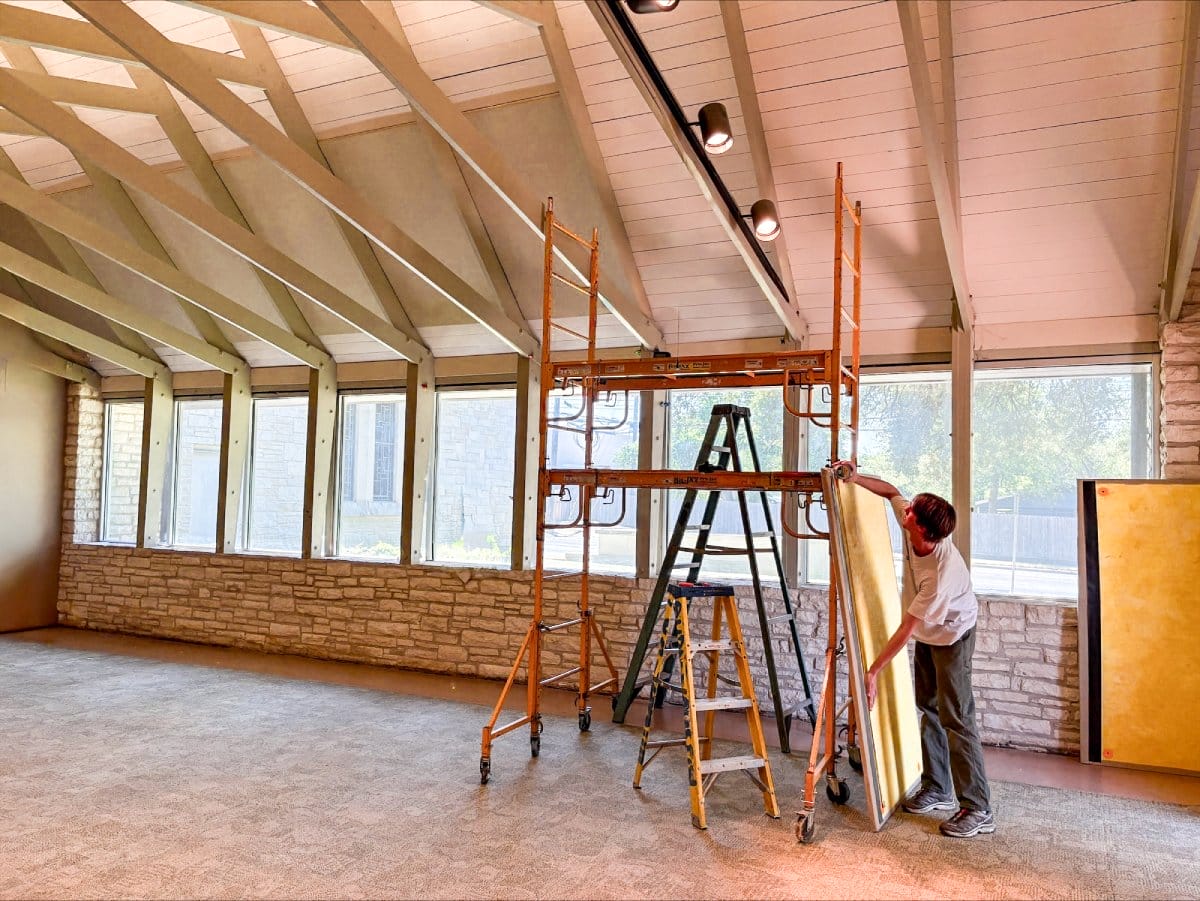
You don’t always need to tear the building to the studs to make meaningful improvements. In remodels, the goal is to add performance where it counts without disrupting daily operations.
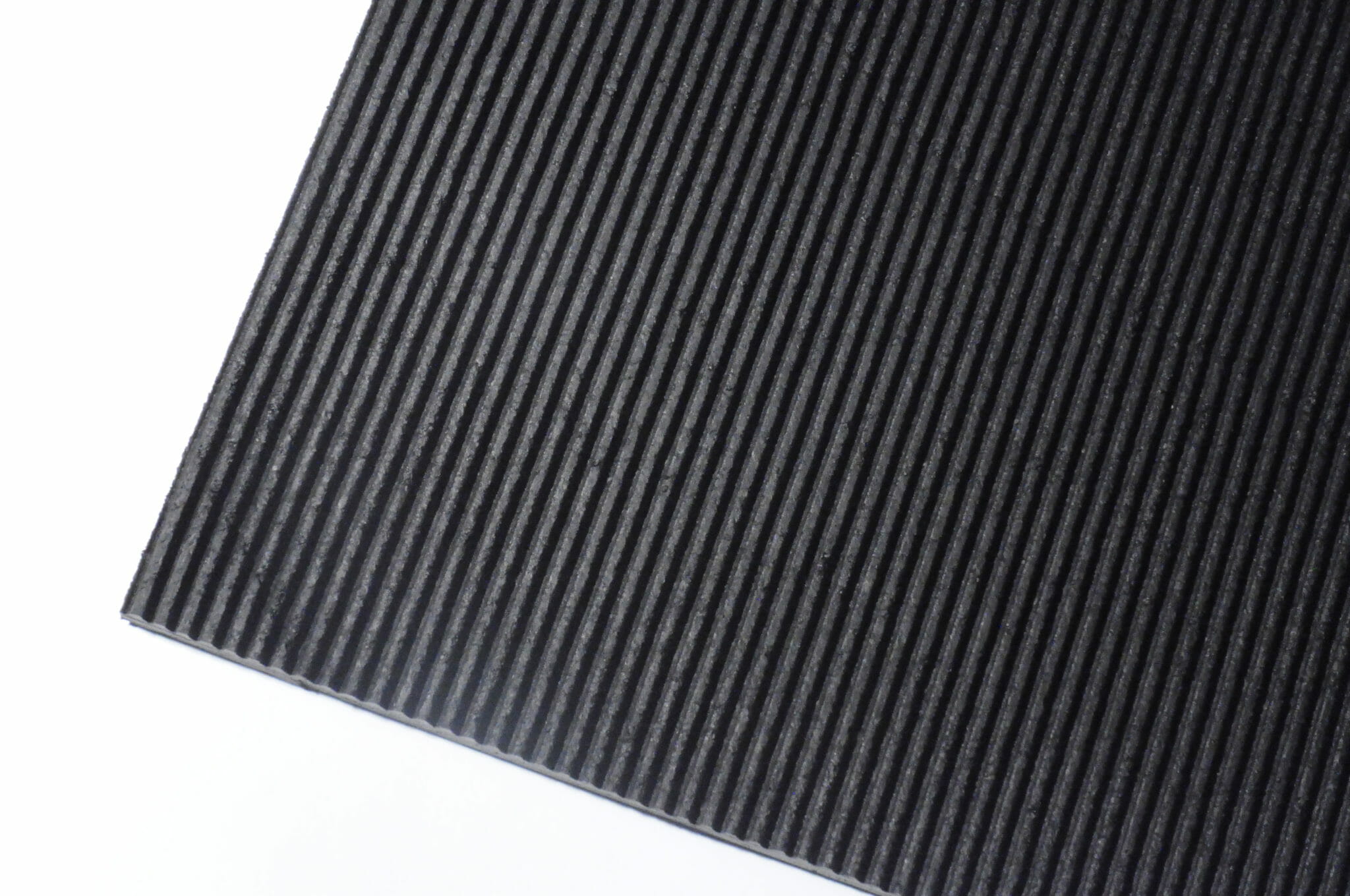
A second layer of ⅝” gypsum with Green Glue vibration damping compound on the noisy side of the wall is one of the highest-value upgrades. Where structure allows, adding resilient clips (with retro-washers if installed directly over drywall) and hat channel on one side introduces decoupling without a full rebuild. And because small gaps are notorious for causing noise leakage, sealing perimeter joints, penetrations, and back-to-back electrical boxes with acoustical sealant / acoustic caulk and putty pads closes off many hidden leaks.
Ceilings can often be improved by swapping lightweight tiles for sound barrier ceiling tiles, addressing return-air paths, and tightening any exposed flanking paths above the grid.
Managing Expectations Around Commercial Glass
Glass is essential for daylighting and visibility – but it’s also one of the weakest materials for sound isolation. Because glass has low mass and limited damping, it rarely performs like a full wall unless you choose the right type and support it with strong framing and sealing.
Manufacturers typically use three tools to improve performance: thicker lites, laminated glass with acoustic interlayers, and double-glazed configurations. With these, many systems reach STC ratings in the low to high 30s, depending on the frame and airspace. They can provide impressive reductions, but no configuration delivers complete isolation.
The best lever in mainstream interiors is careful framing and sealing. Proper perimeter compression, sealed head channels, and supportive surrounding assemblies make a dramatic difference. In higher-stakes areas, vestibules or offset glass partitions add distance and force the sound to take the long way around, improving isolation without resorting to specialty storefront systems.
Don’t Forget What’s Inside the Room
Isolation controls noise between rooms; acoustic treatment controls how a room actually sounds. In commercial settings, pairing the two is what separates a functional space from one that feels pleasant, efficient, and professional.
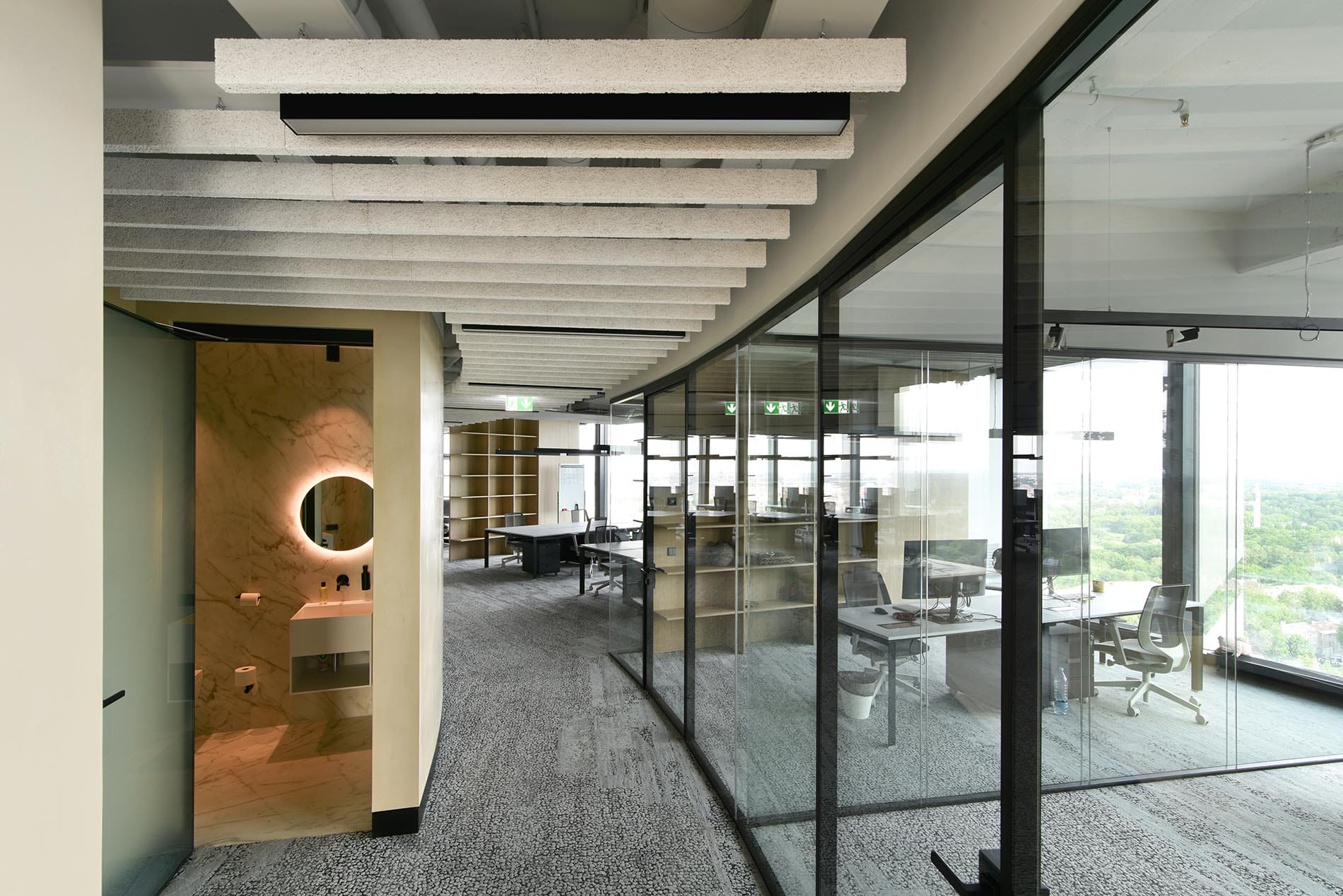
Treatments come in a handful of dependable forms. Ceiling baffles or clouds help in high, reflective spaces like gyms or event halls. Wall-mounted options – such as fabric-wrapped acoustic panels, PET felt panels, Sound Silencer panels, micro-perforated metal panels-Silk Metal micro-perforated panels – reduce echo without overwhelming the architecture. And in performance, recording or listening settings, a touch of diffusion helps keep speech and music sounding natural while avoiding slapback.
Together, these treatments make conversations clearer, reduce vocal strain, and help staff and guests feel more comfortable – an especially important factor in today’s mixed remote / on-site work environments.
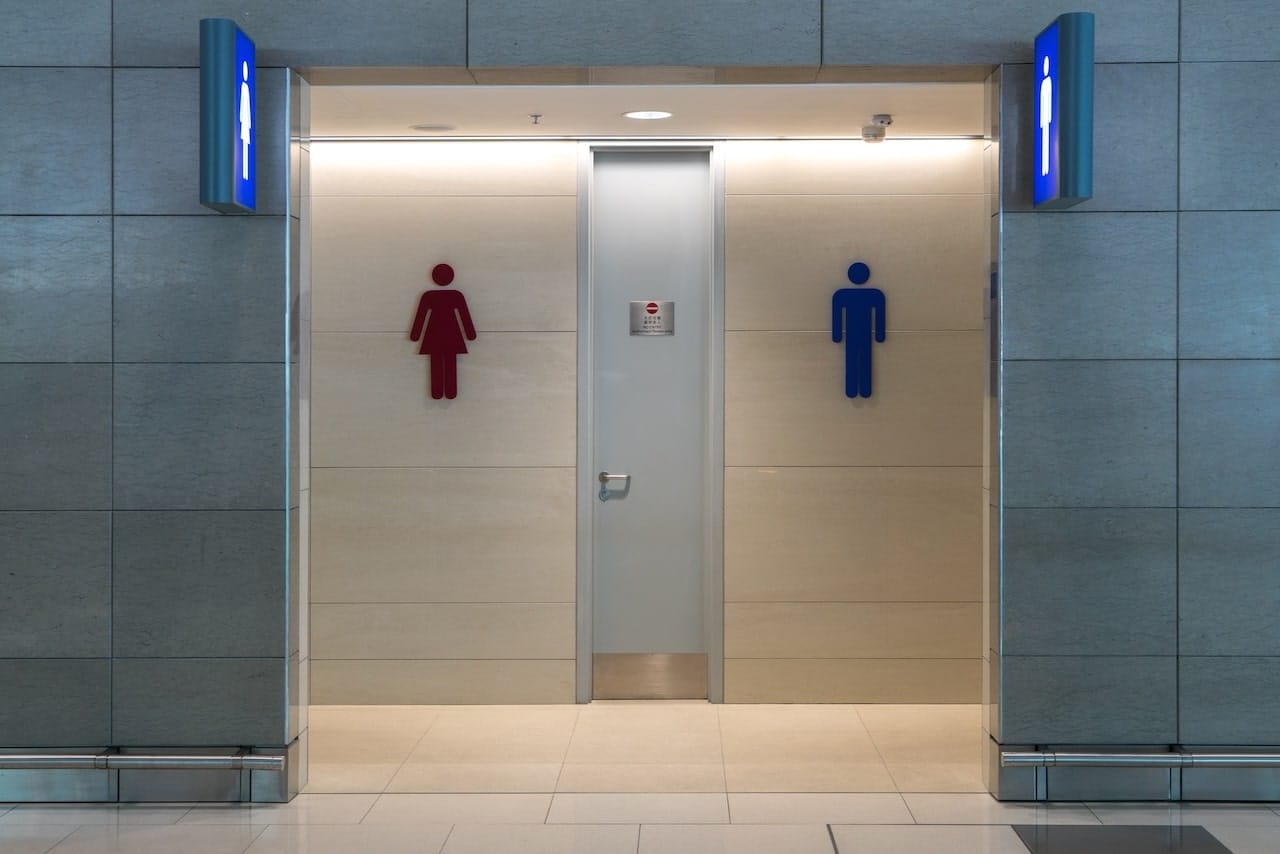
Some spaces benefit from specialized treatment strategies. Commercial restroom acoustics, for example, often rely on cleanable acoustic panels or moisture-resistant perforated vinyl ceiling tiles to control harsh reflections without sacrificing hygiene. In more design-forward interiors, perforated metal acoustic panels balance durability with a modern finish. And inside any treated room, don’t forget the perimeter – sealing flanking paths around soffits, columns, and mechanical penetrations ensures the room performs as well as the materials you’ve selected.
5 Takeaways for Owners & Designers
Owners and design teams get the best results when they approach acoustics in the same way they approach structure or mechanical systems: define the intent early and build accordingly. A few principles consistently deliver the most reliable gains.
First, budget at the assembly level. A small package of clips, damping, and seals often outperforms large but inefficient upgrades. Second, treat floors early; the right underlayment prevents many complaints below. Third, fix the door gap – seals and automatic door bottoms protect the investment you’ve made in the walls. Fourth, stay realistic about glass and rely on laminate, good frames, and flanking control. And finally, pair isolation with treatment so both the room-to-room performance and the in-room comfort work together.
When to Turn to The Pros
Commercial soundproofing has many moving parts, and the details matter. If you’re unsure where the leaks are coming from – or if you want a predictable result the first time – Acoustical Surfaces can help you evaluate assemblies, choose materials, and design a path forward that fits your budget and construction schedule. A short consultation helps you avoid the trial-and-error that often undermines commercial soundproofing benefits and keeps your project aligned with the acoustic performance you’re paying for.
By consulting with experts to cut off sound issues before they become full-blown problems you can improve client satisfaction and drive up the value of your commercial property quickly. There are many ways to address acoustic issues. Find the right solutions for you.