

 Acoustical Ceiling Tiles
Top 10 Sound Control Methods: How to Find Your Best Solution
Good sound control isn’t as simple as adding a few random products – it’s about applying the right strategy to the right problem. An office may have a “soundproofed” wall where conversations still carry, or a multifamily unit may have footsteps from above that never seem to go away. These situations are often treated as the same issue, but they’re not. Echo, noise transfer, and background noise behave differently and need to be addressed that way.
These issues usually come down to one thing: misunderstanding what kind of problem you’re actually trying to solve. Sound control is really a combination of blocking sound transmission, reducing echo, and managing noise at the source – but each of those requires a different strategy. Get that part wrong, and you’ll spend money without fixing the problem.
In practice, most building sound control solutions fall into two categories: absorption (to improve how a space sounds inside) and isolation (to stop sound from traveling between spaces). If you misidentify which one you need, the rest of the project won’t perform the way you expect. The sections below break down where each approach works – and where it doesn’t.
Top 10 Sound Control Solutions
Pick the Ones That Match Your Problem
1 – Acoustic Wall Panels for Echo and Speech Clarity
If a room sounds harsh, loud, or tiring, this is usually where you want to start. Acoustic wall panels are one of the most efficient ways to reduce echo in large rooms and improve speech intelligibility and they can be installed easily by anyone with a few basic tools.
They’re especially effective in classrooms, lobbies, and conference room acoustic treatment, and they’re one of the most reliable classroom solutions when speech clarity is the priority. When shopping, look closely at acoustic wall panels NRC ratings – this tells you how much sound energy the panel absorbs. Higher values mean more effective control.
Durability and cleanability matter too, especially in high-traffic or healthcare settings, so be sure to choose panels that meet local safety and maintenance requirements.
2 – Ceiling Clouds & Baffles for Large/Open Spaces
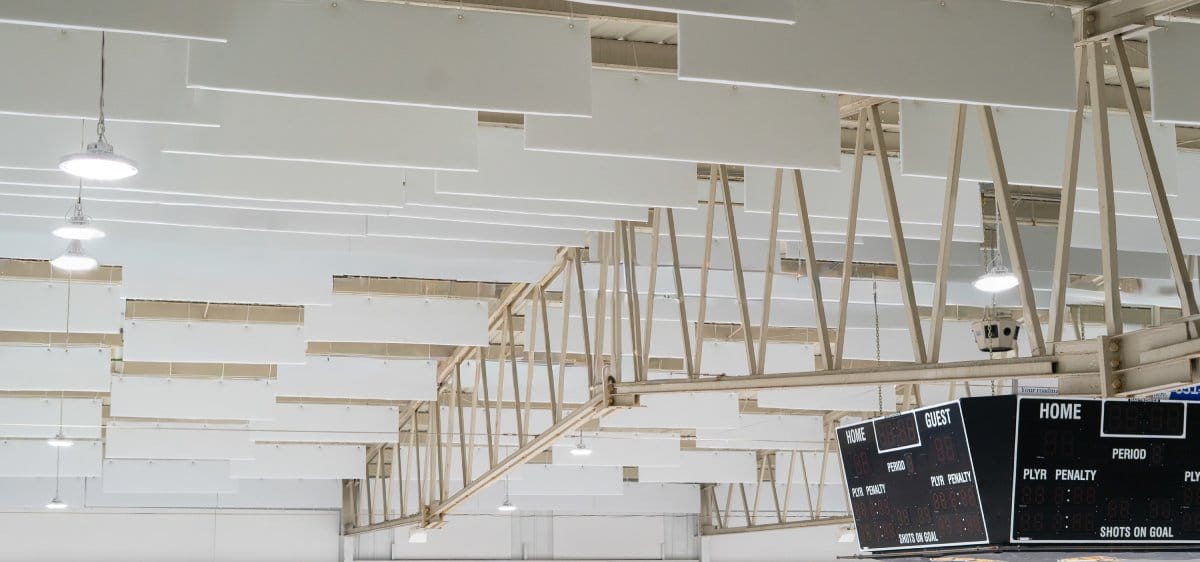
In big, open environments, the ceiling is typically the primary culprit. It’s often the largest uninterrupted reflective surface, which is why ceiling clouds and acoustic systems like baffles can be so effective.
They’re ideal for gymnasium acoustics, cafeterias, and long corridors where wall space is limited. These treatments reduce reverberation time and take the edge off loud environments, making them less fatiguing.
That said, clouds aren’t always the best recommendation. Direct-mounted ceiling panels often provide better coverage and consistency. Use suspended treatments strategically when you need to target specific zones or deal with very high ceilings.
3 – High-Performance Ceiling Tiles (When You Have a Grid)
If you already have a drop ceiling, upgrading the tile is a practical move. High-performance acoustical tiles help with both overhead reflections and some degree of room-to-room noise transfer. Plus, installation is incredibly simple.
However, you’ll want to keep your expectations realistic. Even with barrier-backed tiles, true isolation is limited because of gaps, penetrations, and shared plenum spaces. This is one of those commercial soundproofing options that works best as part of a broader system, not as a standalone fix.
4 – Sealants & Gap-Sealing (A Cheap and Easy “Soundproofing” Upgrade)
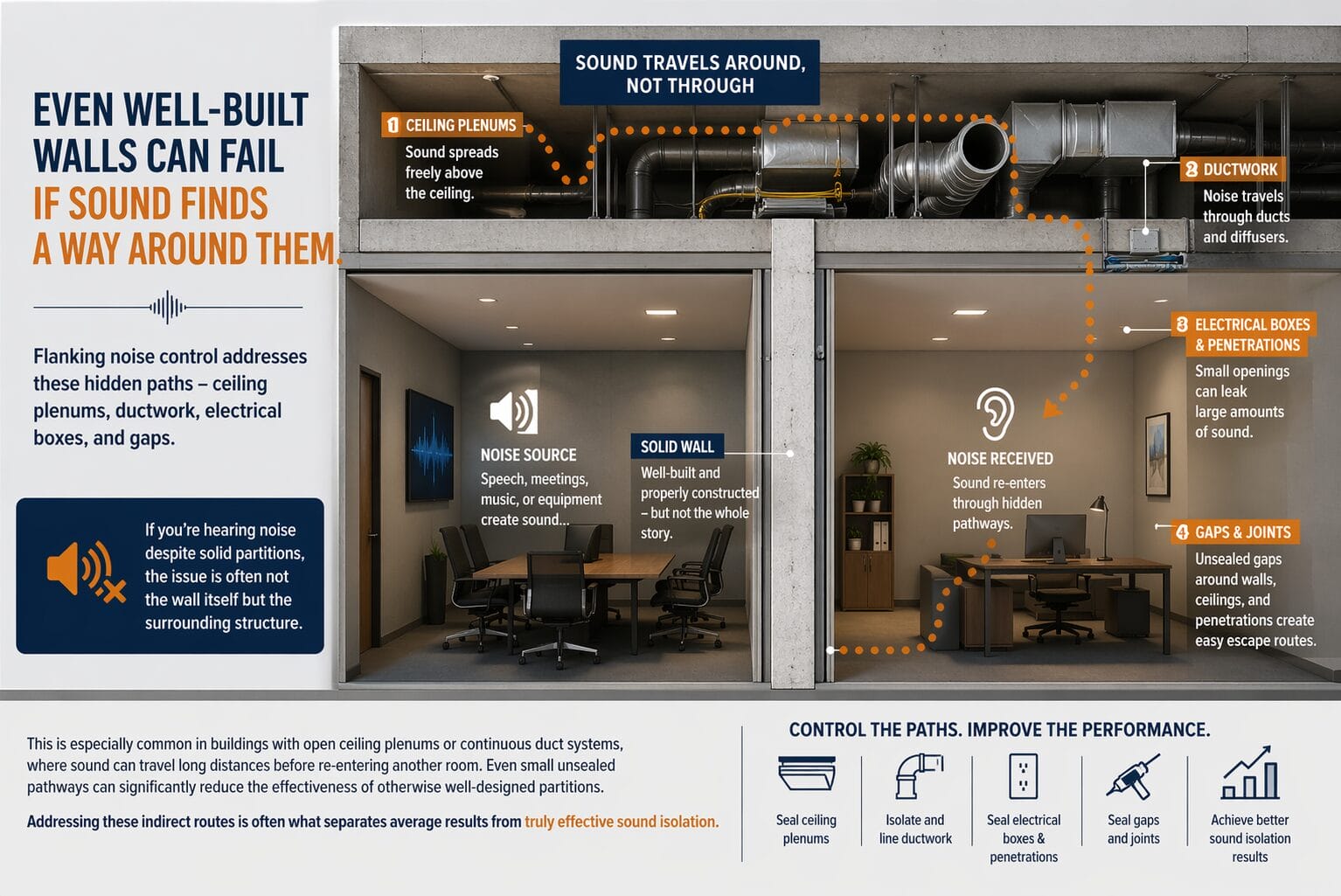
This is the one of the most overlooked steps – and often the most important. Sound behaves like water, so if there’s a gap, it will find it and flow through.
Before investing in larger upgrades, seal everything. Focus on things like perimeter gaps, electrical boxes, and pipe penetrations. This applies to nearly every type of noise control problem and is one of the simplest STC improvement methods available.
As a simple rule: seal first, then add materials. Skipping this step is enough to undermine even the best soundproofing plan.
5 – Soundproof Doors + Perimeter Seals (Privacy Starts Here)
Doors are almost always the weakest link in a wall assembly. You can build a high-performing wall, but if the door leaks sound, sound will still pass through.
Soundproof door seals, automatic door bottoms, and properly rated door assemblies make a big difference. This is an essential setup for executive offices, counseling rooms, and meeting spaces where speech privacy matters.
6 – Soundproof Windows
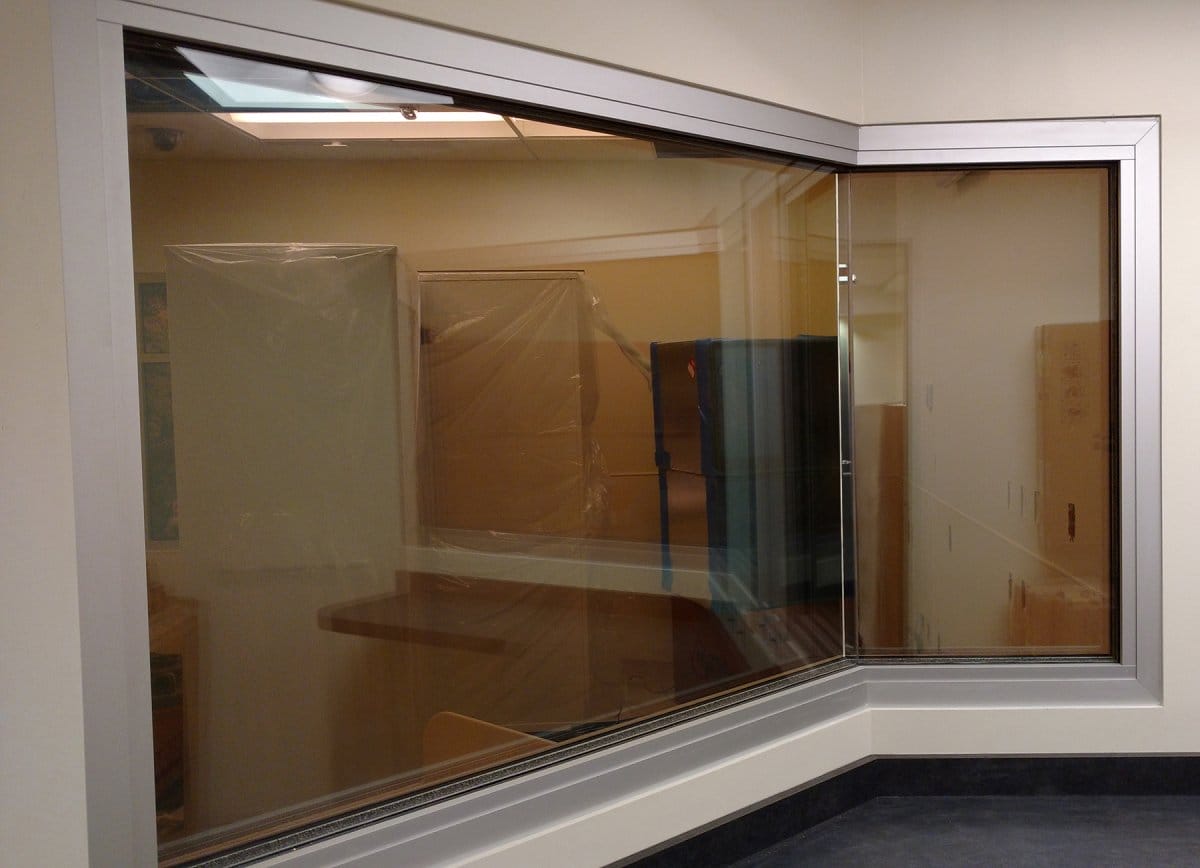
Windows usually show up as weak points in two ways: sound leaking between rooms and noise coming in from outside.
For interior openings, more panes and larger air gaps can improve isolation. For exterior problems – especially when you’re dealing with soundproof windows for traffic noise, aircraft, or dense urban environments – window inserts are often the better move. They improve performance without replacing the entire window system and can be removed when you need access or fresh air.
Full replacement isn’t always necessary. In many cases, inserts get you most of the performance with far less cost and disruption.
7 – Wall Soundproofing Systems
When you’re dealing with noise traveling between rooms, the solution you’re after is isolation – not absorption. This is where mass, damping, and decoupling come into play.
Adding dense materials like mass loaded vinyl or an extra layer of ⅝” drywall increases mass. Damping compounds like Green Glue placed between layers reduce vibration transfer. Decoupling systems (like resilient clips) limit structural transmission. Together, these approaches form the backbone of effective building sound control solutions.
These systems are commonly used in multifamily buildings, hospitality, and medical environments where privacy expectations are higher.
8 – Floor Impact Noise Control (Underlayments + IIC Strategy)
Impact noise is a different problem than airborne sound, and it gets mishandled all the time. Sounds of footsteps, dropped objects, and rolling chairs don’t travel primarily through the air – they go straight into the structure and show up below.
This is why floor impact noise reduction in multifamily buildings, hotels, and stacked office spaces can be so frustrating.
Most solutions focus on underlayments, but this is where people oversimplify. Not every underlayment works with every finish floor, and chasing a high IIC rating on paper doesn’t always translate into real-world performance.
If you’re working on this type of problem:
- Start with the assembly, not just the product
- Make sure the underlayment matches the floor finish (LVT, tile, hardwood all behave differently)
- Don’t ignore flanking paths at the perimeter
On its own, and underlayment helps – but it won’t fix structure-borne noise if the rest of the assembly is working against you. This is one of those areas where details matter more than specs.
Read More: How Much Does it Cost to Install Soundproof Floor Underlayment?
9 – Ceiling Sound Control (When Noise Comes From Above)
When noise is coming from above, it’s rarely just one issue. What sounds like footsteps could also include airborne noise or sound finding its way around the structure.
Ceiling treatments can help, but only if they match the problem. Sometimes you need added mass and isolation. Other times, targeted absorption is enough to take the edge off. If you take the wrong path, the noise doesn’t go away – it just changes.
10 – HVAC Noise Control (Duct Liner/Wrap + Cross-Talk Prevention)
Mechanical systems are a hidden source of noise problems. HVAC duct noise includes fan hum, airflow turbulence, and even voice transmission between rooms.
Duct liner and wrap address noise at the source, while proper design prevents cross-talk between spaces. If untreated, ducts can bypass otherwise well-designed partitions.
Treat both the equipment and the pathways, as ignoring either one leaves the problem unresolved.
How to Choose the Best Solution (3-Step Selector)
Step 1: Identify the problem type
Start by defining what’s actually wrong:
- Echo or harshness → you need absorption
- Privacy issues or next-room noise → you need isolation
- Distractions in an open office → you need absorption + sound masking
This is where understanding sound absorption vs soundproofing becomes essential. Mixing them up is one of the fastest ways to spend money and still have the same problem.
Step 2: Identify the pathway
Next, determine how sound is traveling:
- Through air: gaps, doors, windows
- Through structure: walls, floors, framing
- Through mechanical systems: ducts and shared systems
Flanking noise control is especially important here. Sound rarely takes the direct path – it finds the easiest one.
Step 3: Match the solution to the surface
Once you know the problem and the pathway, match it to the right surface:
- Walls → panels or isolation systems
- Ceilings → tiles, mounted panels, or structural upgrades
- Doors → seals and upgraded assemblies
- Windows → inserts or window upgrades
- Floors → underlayment and impact control systems
A simple way to think about it:
Problem → Pathway → Solution Category → Product Type → First Action
For example:
Speech privacy issue → door gaps → isolation → door seals → seal perimeter first
This structured approach prevents overbuilding and keeps budgets focused where they matter.
Common Building Zones (Fast Recommendations)
Different spaces have predictable issues. Instead of starting from scratch every time, use these as baseline strategies.
Conference rooms
Start with acoustic wall panels and ceiling treatment to improve speech intelligibility. Add soundproof door seals to prevent leakage.
Open office environments
Sound control for open office layouts requires a layered approach: ceiling absorption, wall panels, and sound masking to manage distractions.
Corridors
Corridor noise reduction focuses on durable ceiling tiles, wall panels, and sometimes carpet tile to limit reflections and footfall noise.
Healthcare spaces
Combine isolation (walls, doors, sealing) with controlled absorption to create quieter, less stressful environments.
Multifamily buildings
Focus on floor/ceiling assemblies for impact control and upgrade wall systems using proven STC improvement methods.
Get a Building-Specific Sound Control Plan
Every project has constraints – budget, structure, usage, and the right solution comes from aligning those with the actual noise problem. If you’re trying to improve speech intelligibility in a conference room, reduce HVAC noise in an office, or address floor impact noise in multifamily buildings, the approach should be specific, not generic.
The most effective way to get there is to start with real information: room dimensions, surface materials, photos, and a clear description of the issue. From there, you can build a targeted plan using the right combination of absorption, isolation, and noise control strategies.
If you’re serious about sound control, don’t guess. Match the solution to the problem, and you’ll get results that actually hold up in real-world use.