

 Acoustical Ceiling Tiles
Occupational Noise: Soundproofing for Industrial Workspaces & Factories
Factories and industrial workspaces are rarely quiet. Motors run continuously, machinery cycles through production tasks, and equipment generates everything from low-frequency hums to sharp, intermittent impacts. Add hard floors, metal surfaces, and high ceilings, and sound can accumulate throughout the facility. While some level of noise is unavoidable, excessive occupational noise can create serious problems for the people working in these environments.
Prolonged exposure can lead to permanent hearing damage, while high background noise makes it harder for employees to communicate, recognize warning signals, and follow instructions. Effective industrial soundproofing begins with understanding what’s generating the noise and how it reaches workers. Depending on the source, the solution might involve modifying equipment, interrupting sound transmission, or reducing reflections within the workspace.
What Is Industrial Noise Control?
Industrial noise control refers to the methods used to manage unwanted sound generated by machinery, manufacturing processes, ventilation systems, and other workplace equipment. The objective is to reduce harmful noise exposure and improve acoustic conditions without interfering with normal operations.
Most industrial noise problems can be approached at three points: the source generating the sound, the path it travels, and the workers or areas receiving it. Different treatments address different parts of the process.
For example, sound absorption reduces reflections within a room, while sound barriers and isolation systems limit transmission between areas. Acoustic enclosures contain noise around individual machines, and vibration isolation reduces mechanical energy traveling through building structures. Hearing protection provides an additional safeguard for employees, although it doesn’t reduce the noise generated by equipment.
Effective factory noise control often requires combining several approaches rather than relying on a single treatment.
Why Is Noise Control Important in Factories and Industrial Workspaces?
The most serious consequence of excessive occupational noise exposure is noise-induced hearing loss, which can develop gradually after repeated exposure to hazardous sound levels. Because the damage is permanent, prevention is particularly important in facilities where employees spend entire shifts around loud equipment.
Noise also affects daily operations. Workers may struggle to hear instructions, communicate across production lines, or recognize alarms and approaching equipment. Constant background noise can interfere with concentration and make demanding tasks more difficult.
These concerns extend beyond employee hearing protection. Facilities may also need to address noise entering adjacent work areas, offices, or neighboring properties. Workplace noise control helps manage these problems while supporting a safer, more functional production environment.
What Are OSHA’s Workplace Noise Limits?
The Occupational Safety and Health Administration (OSHA) establishes limits for workplace noise exposure. Under its general-industry standard, 29 CFR 1910.95, the permissible exposure level is 90 decibels A-weighted (dBA) over an eight hour workday. As sound levels increase, the permitted exposure duration decreases.
OSHA Noise Exposure at a Glance
| Exposure duration | OSHA permissible level |
| 8 hours | 90 dBA |
| 4 hours | 95 dBA |
| 2 hours | 100 dBA |
| 1 hour | 105 dBA |
| 30 minutes | 110 dBA |
| 15 minutes or less | 115 dBA |
Source: OSHA 29 CFR 1910.95, Table G-16. Combined exposure at different noise levels must also be considered.
When exposure exceeds these permissible levels, OSHA requires feasible engineering or administrative controls. If those measures are insufficient, appropriate workplace hearing protection must also be provided and used.
OSHA also establishes a separate action level of 85 dBA as an eight-hour time-weighted average (TWA). At or above this threshold, covered employers must implement an OSHA hearing conservation program that includes exposure monitoring, audiometric testing, employee training, and hearing protection requirements.
Requirements can vary by industry and working conditions, so facilities should consult the applicable standards and qualified occupational-safety professionals when evaluating compliance.
OSHA Limits vs. NIOSH Recommendations
OSHA noise limits differ from the recommendations established by the National Institute for Occupational Safety and Health (NIOSH).
NIOSH recommends limiting occupational noise exposure to 85 dBA over eight hours, using a 3-dB exchange rate. Under this recommendation, every 3-dB increase cuts the recommended exposure duration in half. OSHA’s general-industry permissible exposure framework uses a 5-dB exchange rate.
Meeting OSHA’s permissible exposure limits doesn’t necessarily mean workers are protected to the level recommended by NIOSH.
Where Does Industrial Noise Come From?
Industrial facilities rarely have just one source of noise. Motors, compressors, conveyors, presses, cutting equipment, and ventilation systems can all contribute to the overall sound level. Some operate continuously, while others produce sudden bursts of noise during specific production tasks.
Identifying the loudest equipment is a useful starting point, but it doesn’t tell the whole story. Sound can reach employees through the air, travel through the building’s structure, or reflect repeatedly throughout the workspace. Each mechanism presents a different challenge for industrial noise reduction.

Airborne Noise
Airborne noise travels directly from a source through the surrounding air. Common examples include running motors, compressed-air discharge, cutting equipment, exhaust systems, and industrial fans.
Workers near these sources may experience high sound levels even in relatively well-treated spaces. Depending on the equipment and its location, reducing airborne noise may require containing the source, interrupting its transmission path, or treating specific openings and exhaust systems.
Structure-Borne Noise and Vibration
Some machinery transfers mechanical energy into the floors, walls, pipes, and structural components supporting it. That vibration can travel through the building and radiate as audible noise elsewhere.
Pumps, compressors, presses, and rotating equipment are frequent culprits. A vibrating pipe or metal platform, for example, can become a secondary noise source even when the original machine is some distance away.
Because the sound originates from mechanical vibration, adding acoustic panels to nearby walls won’t necessarily help. Machinery vibration isolation and other mechanical treatments may be needed to interrupt its transmission.
Reverberation Noise
Factories and warehouses are often filled with hard, reflective surfaces. Concrete floors, masonry walls, metal ceilings, and production equipment repeatedly reflect sound rather than absorbing it.
When several machines operate at the same time, these reflections can raise background noise throughout the facility. Employees may struggle to communicate even when they’re standing well away from the loudest equipment.
Industrial sound absorption helps control this reverberant buildup by reducing the sound energy that would otherwise be reflected back into the workspace.
How Should You Assess an Industrial Noise Problem?
Before investing in factory acoustic treatment, facility managers need to understand what they’re trying to correct. A noisy production floor might have several contributing sources, and the most obvious machine isn’t always responsible for the greatest employee exposure.
A useful assessment should establish:
- Which machines and processes generate the noise, including intermittent operations.
- Sound levels at employee workstations and how exposure changes throughout a shift.
- Dominant frequencies and whether sound travels through the air, building structure, or both.
- How reflections and transmission between work areas affect overall noise levels.
Sound-level meters help identify noisy locations and equipment, while personal noise dosimeters measure an employee’s cumulative exposure during work activities. Under OSHA’s general-industry standard, monitoring is required when information indicates employee exposure may equal or exceed an eight-hour TWA of 85 dBA.
More detailed acoustic measurements may be needed to identify particular frequencies, vibration paths, or sources of reverberation. These findings provide the basis for selecting appropriate noise control engineering measures and evaluating their effectiveness after installation.
The Most Effective Ways to Reduce Industrial Noise
Once the sources and transmission paths are understood, facilities can begin matching manufacturing noise control strategies to the problem. The most effective approach usually addresses noise as close to its source as practical, although equipment layout, production requirements, and building conditions can influence what’s possible.
Industrial workplaces often need a combination of treatments. A machine enclosure might reduce noise reaching nearby employees, for example, while ceiling absorption helps manage the sound that continues to circulate throughout the building.
Reduce Noise at the Source
Sometimes, the simplest way to quiet a noisy machine is to address what’s making it noisy in the first place. Worn bearings, loose components, excessive reverberation, and repeated metal-on-metal impacts can generate significant noise during normal operation.
Routine maintenance, equipment adjustments, and quieter replacement components may provide meaningful machine noise reduction. Other options include damping vibrating surfaces, installing silencers on compressed-air systems, or selecting quieter equipment when machinery is replaced.
Source-focused improvements are especially valuable because they can reduce noise before it spreads into surrounding work areas.
Enclose Loud Machinery
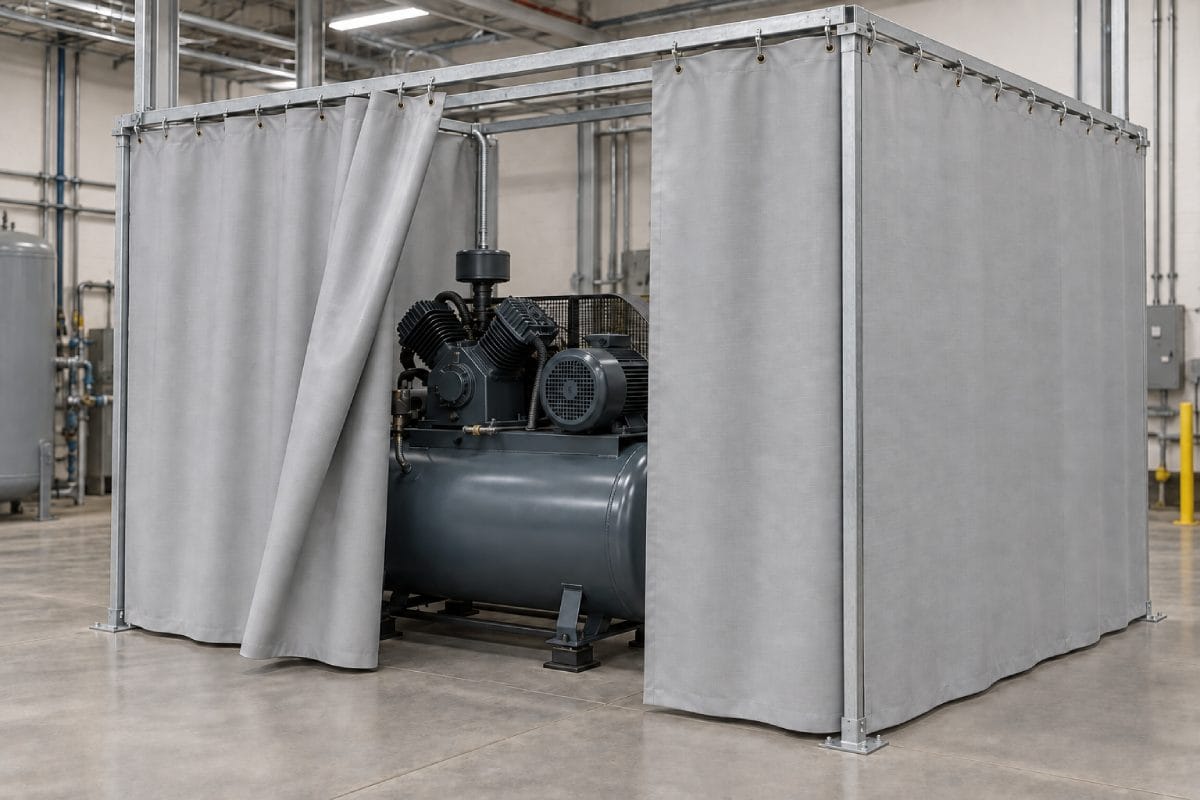
When an individual machine generates excessive noise, surrounding it with a sound-reducing enclosure can be more effective than treating the entire production floor.
A properly designed soundproof machine enclosure combines sound-blocking construction with interior absorption to contain noise near its source. Enclosures can accommodate doors, windows, ventilation, and maintenance access, although these features must be carefully designed to preserve acoustic performance.
Industrial acoustic enclosure systems are particularly useful for compressors, generators, pumps, and other equipment that operates in a relatively fixed location.
Add Barriers or Acoustic Curtains Between Noise and Workers
Full enclosures aren’t practical for every production process. Equipment may require frequent access, material movement, or an open connection to surrounding workstations.
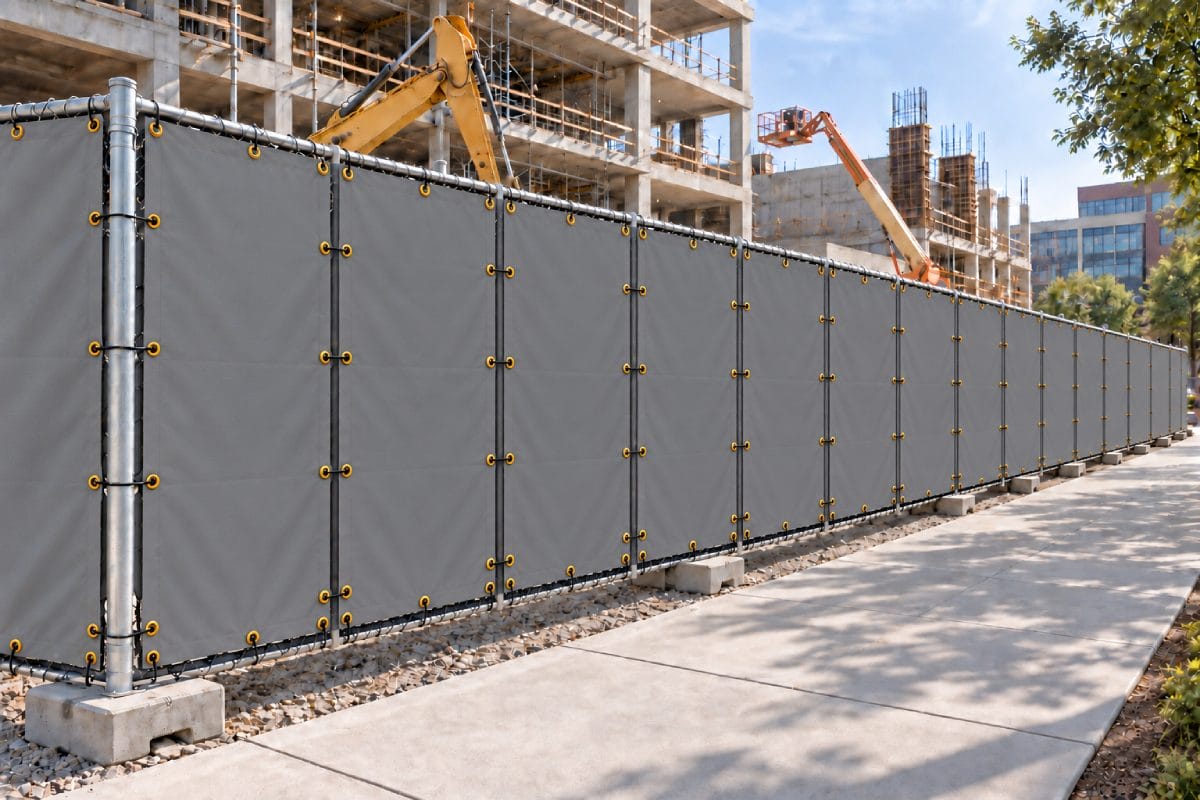
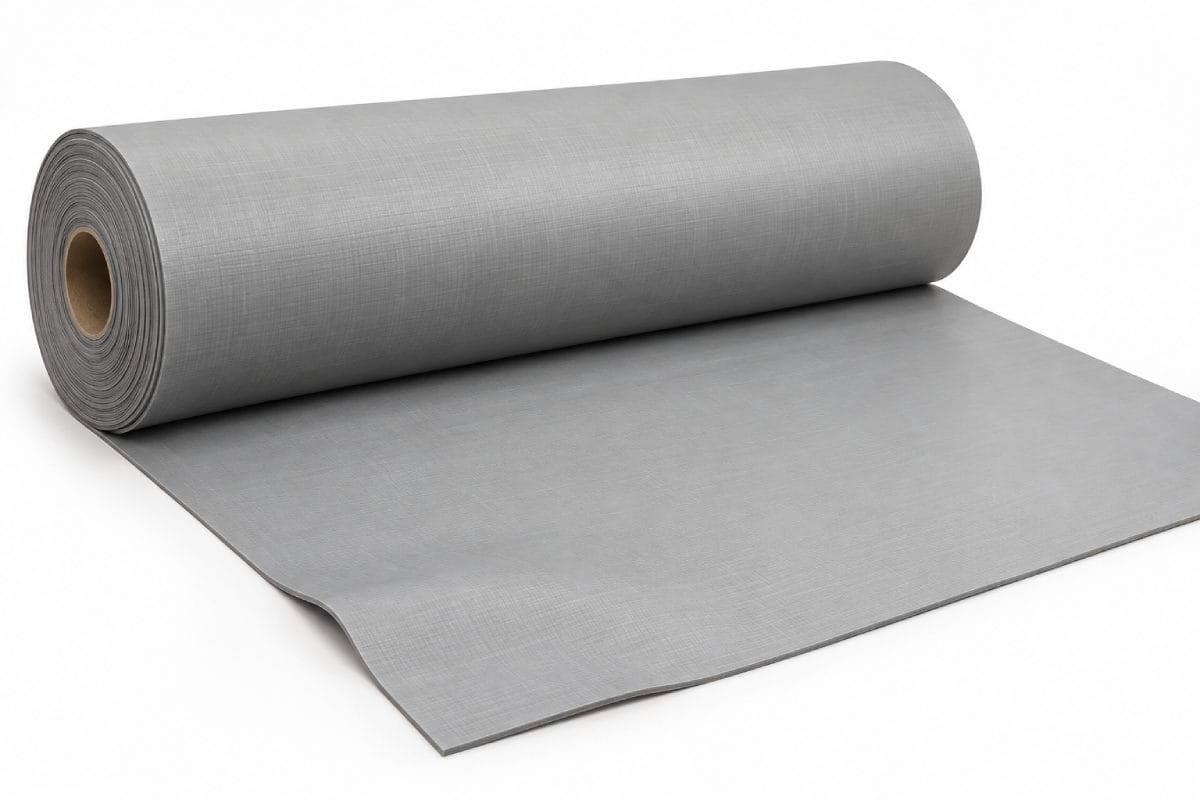
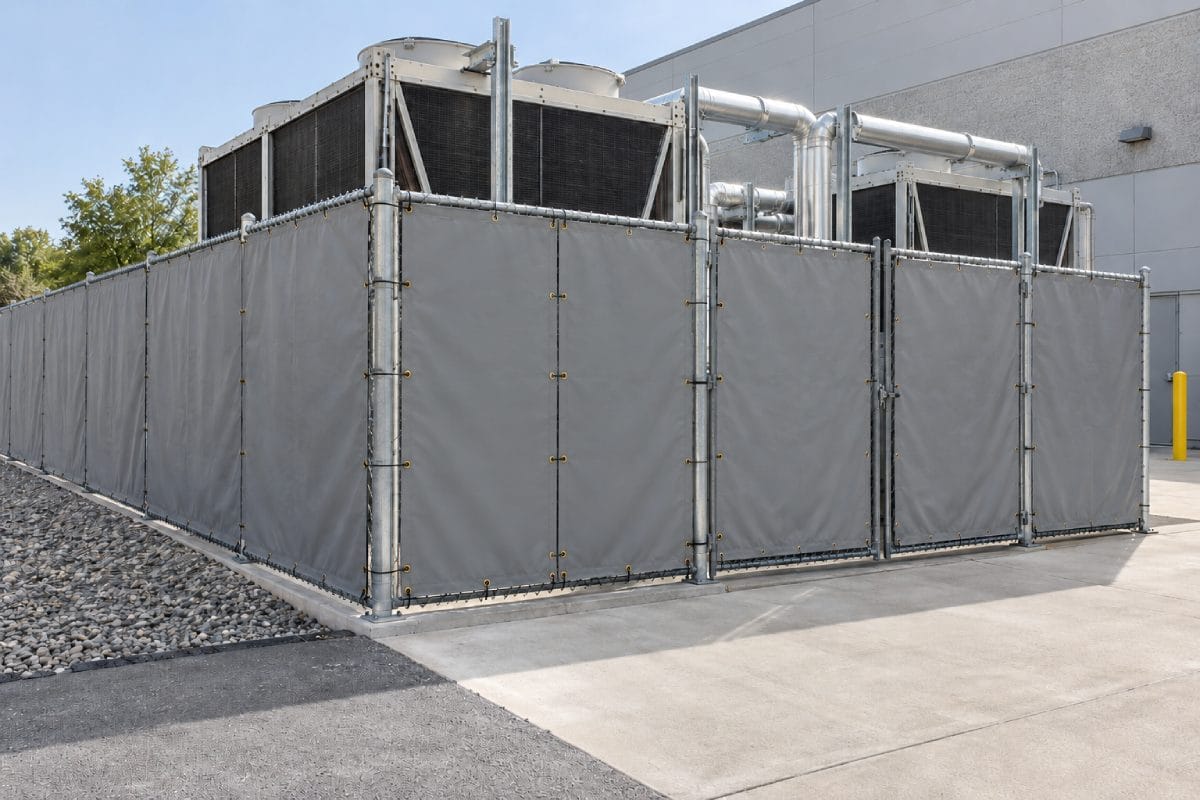
Industrial sound barriers offer another option by interrupting the direct path between noisy equipment and nearby employees. Fixed partitions, portable screens, and sound barrier curtains can help separate work cells or shield occupied areas. Mass loaded vinyl can also provide a flexible sound-blocking layer within properly designed barrier assemblies.
Flexible quilted curtains are particularly useful where equipment access or production layouts change regularly. Depending on their construction, these systems can combine sound-blocking and absorptive materials to control transmission and reflections.
Add Absorption to Walls and Ceilings
In large manufacturing spaces, reflective surfaces can allow noise from multiple machines to build up throughout the room. Industrial acoustic panels, ceiling absorbers, and acoustic baffles for factories help reduce these reflections.
These treatments are useful for lowering reverberant noise and improving communication across open production floors. Products such as Sound Silencer acoustic panels and CFAB cellulose acoustic panels provide options for different installation requirements.
However, absorption has its limits. Wall panels won’t necessarily quiet a nearby press or prevent machinery noise from entering an adjacent office. Those problems may require barriers, enclosures, or sound-isolating construction.
Isolate Vibration
When machinery transmits vibration into a building’s structure, isolation mounts, resilient pads, spring isolators, and flexible connections can help reduce the transfer of mechanical energy.
The right solution depends on equipment weight, operating speed, vibration frequency, and supporting structure. Poorly selected isolators can provide little improvement or even amplify vibration, so complex installations often require engineering assistance.
Acoustic Enclosures vs. Barriers vs. Absorptive Panels
Different treatments solve different problems. This comparison provides a quick reference for selecting an appropriate starting point.
| Solution | Primary function | Typical application |
| Machine enclosure | Contains noise source | Loud individual machines |
| Acoustic curtain or barrier | Interrupts sound transmission | Production cells and equipment |
| Wall or ceiling absorption | Reduces reflected sound | Reverberant factories |
| Vibration isolation | Limits structure-borne noise | Pumps and motors |
| Silencer | Controls airflow noise | Ducts and exhaust systems |
| Hearing protection | Reduces exposure at the ear | Employee protection when required |
Several approaches may be necessary to achieve meaningful reductions, particularly in facilities with multiple noise sources.
How to Plan an Industrial Noise-Control Project
A successful noise-control project needs to account for more than acoustic performance. Production schedules, equipment access, ventilation, cleaning requirements, and fire safety can all influence which treatments are practical.
Facility managers should work with qualified professionals to select treatments that address the identified noise sources without interfering with daily operations. Once installed, the solutions should be evaluated through follow-up measurements to confirm that noise levels and employee exposure have improved.
Choosing Industrial Noise-Control Products for Your Facility
Acoustical Surfaces offers a range of industrial noise control solutions for manufacturing facilities, from quilted acoustic curtains and portable sound screens to absorptive panels and complete acoustic machine enclosures.
The right combination depends on the equipment, workspace, and how sound reaches employees. Whether you’re dealing with one particularly loud machine or noise throughout an entire production floor, our team can help identify appropriate treatments.
Contact Acoustical Surfaces to discuss your facility’s occupational noise challenges and find a solution that fits your operations.