

 Acoustical Ceiling Tiles
Soundproofing Open-Concept Office Spaces: Balancing Collaboration and Privacy
Open office soundproofing is one of the most misunderstood topics in workplace design. Nearly every week, organizations reach out hoping to block conversations between workspaces, eliminate distractions, or make an open floor plan feel like a series of private offices. The problem? From a physics standpoint, those expectations are impossible to meet.
Open-concept environments, by definition, share air between people and different spaces. Sound travels through the shared air freely. That means true isolation – what most people mean when they say “soundproofing” – is not feasible without things like walls and doors that eliminate or greatly reduce the amount of shared airspace from one area or work station to another. Pretending otherwise does a disservice to business owners, facilities teams, and employees alike.
Meaningful office noise reduction is not impossible, however. Lowering overall loudness, shortening reverberation, improving comfort, and increasing perceived speech privacy can make a space much more usable. With the right mix of materials, layout decisions, and realistic expectations, you can create a space that supports both collaboration and focus – even if it will never behave like enclosed offices.
This guide explains how to approach open office acoustics honestly, practically, and effectively.
Why Open Offices Get So Noisy and What “Soundproofing” Really Means
Before getting into solutions, it’s important to understand the mechanics of why open offices behave the way they do. Most frustration stems from a mismatch between expectations and how sound actually travels. People often assume that if a space looks visually divided – or if acoustic products are added – it should behave like separate rooms. In reality, without physical barriers that fully separate air between spaces, sound will always travel farther than most occupants expect. Understanding the underlying causes of noise is the foundation for making smart, realistic decisions about treatment.
Open offices are loud for three primary reasons:
- Reflection – Hard surfaces (drywall, glass, concrete, metal) bounce sound around.
- Reverberation – Those reflections linger in the space instead of dying out quickly.
- High speech intelligibility – Human speech remains clear across long distances, which increases distraction.
When people ask for “soundproofing,” they usually want one of three outcomes. It helps to separate these using the ABCs of acoustics:
- Absorb: Use materials like acoustic wall panels, acoustic ceiling tiles, ceiling sound absorbers, and acoustic baffles to reduce reflections and control reverberation.
- Block: Use physical barriers such as walls, higher office partitions, or enclosed rooms to interrupt direct sound paths.
- Cover: Use background sound (like HVAC noise or sound masking for offices) to reduce speech intelligibility.
Here’s the truth:
Absorption improves comfort. Blocking requires construction. Covering changes perception. None of these creates real isolation in a shared-air environment.
That’s why open office soundproofing, in the literal sense, is not achievable in open layouts.
Measuring performance in open offices
Instead of focusing on “soundproof or not,” acousticians evaluate open-plan spaces using standards like ISO 3382-3, which introduces metrics such as:
- Distraction distance (rD) – How far speech carries before it becomes distracting.
- Privacy distance (rP) – How far speech carries before it becomes unintelligible.
These concepts reinforce an important point: in open plans, the goal isn’t silence. The goal is reducing how far speech travels clearly.
Targets and Standards for Open-Plan Offices
Rather than promising privacy, effective open office acoustics focuses on practical performance targets.
Common guidelines include:
- Noise Criteria (NC) ≤ 40 for general open office environments.
- Treating at least 25% of wall surface area with materials rated NRC ≥ 0.8 as a baseline design rule.
- Using ceiling absorption strategically to control overall reverberation.
These targets support better outcomes in terms of distraction distance and privacy distance as defined in ISO 3382-3. However, it’s also important to understand that background noise levels strongly influence these metrics. Increasing background noise (whether through HVAC or sound masking for offices) can reduce speech intelligibility – but it does not eliminate sound transmission.
Step-by-Step Plan to Reduce Noise (ABCs)
The most effective acoustic improvements come from layering strategies rather than relying on a single product type. Think of this as a system, not a shopping list. Absorption typically delivers the biggest comfort gains, blocking provides limited but situational benefit, and covering can fine-tune perception when used carefully. The order matters, too: skipping ahead to partitions or masking before addressing reflection and reverberation usually leads to disappointing results. The sections below explain how each layer works, where it helps most, and where its limitations need to be clearly understood.
Absorption: Acoustic Panels, Ceiling Tiles / Clouds / Baffles
Absorption is usually the first and most impactful step in office noise reduction.
Wall-mounted solutions
- Acoustic wall panels reduce reflections and improve speech clarity.
- Placement should prioritize areas near talkers: behind collaboration zones, along main circulation paths, and near noisy departments.
Ceiling solutions
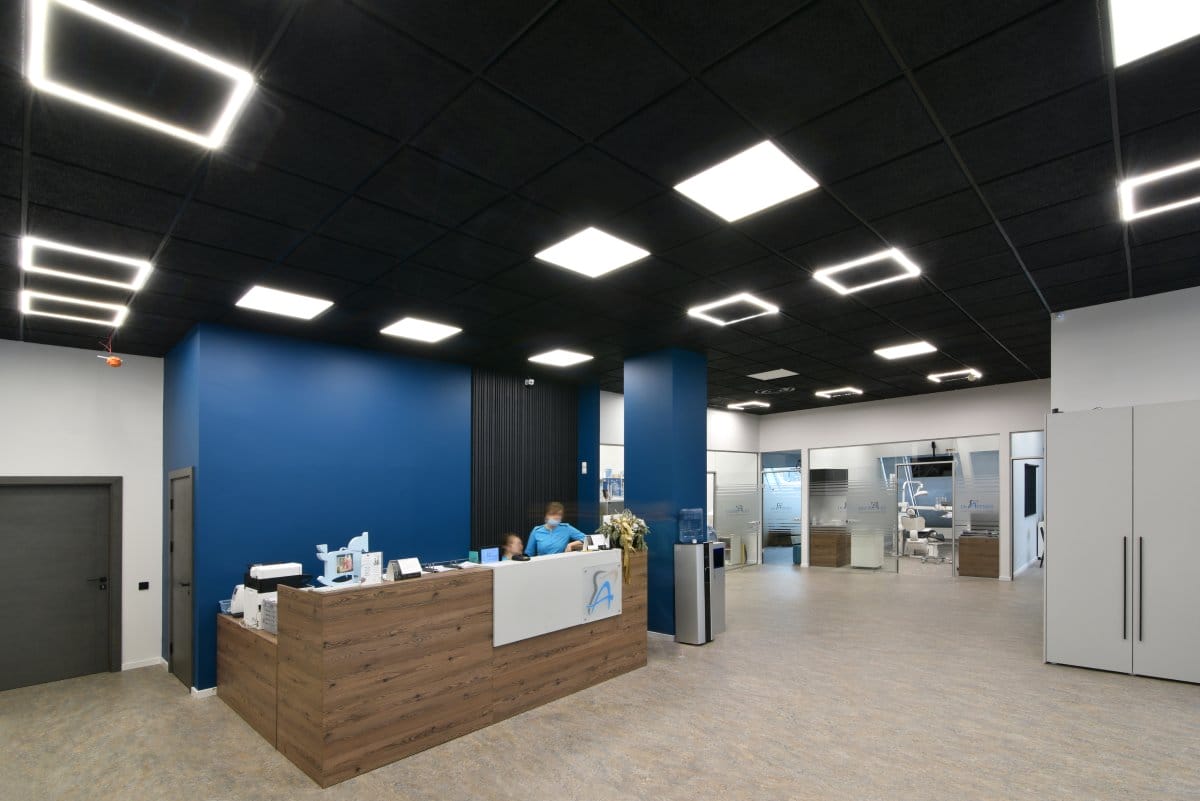
- Acoustic ceiling tiles replace standard grid tiles and provide broad reverberation control.
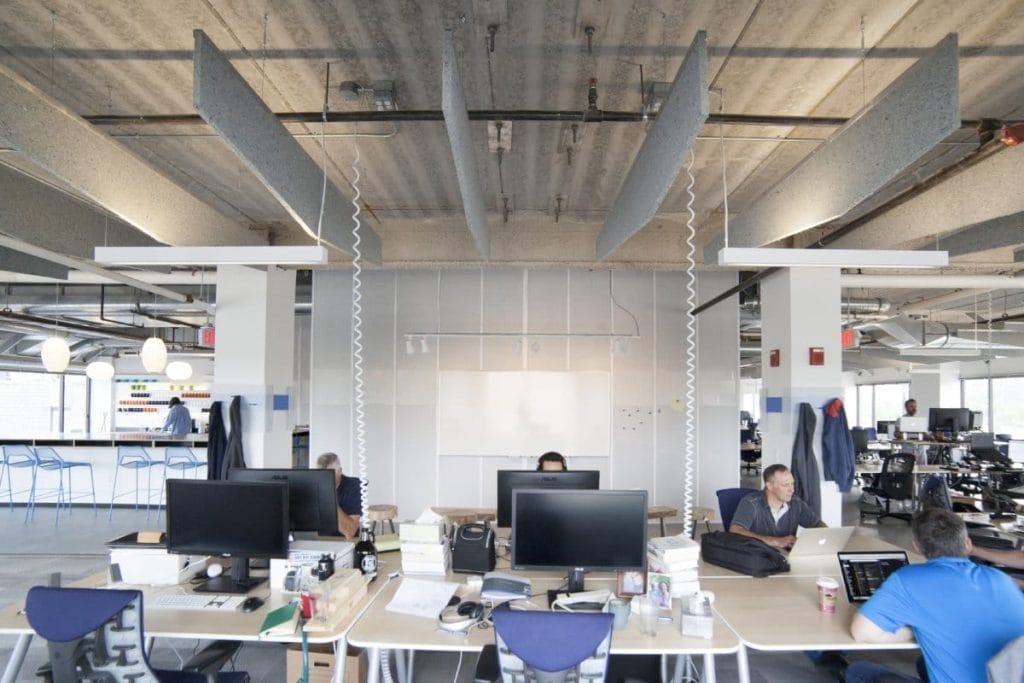
- Acoustic ceiling clouds and acoustic baffles are suspended ceiling sound absorbers used when wall space is limited or ceilings are high.
Important caution: Many offices have fire suppression systems. Hanging clouds or baffles can violate fire code requirements if not coordinated with building management. Always confirm compliance before specifying suspended products.
Clouds and baffles are extremely similar in performance. Other than orientation and visual appearance, there is little functional difference. Both typically offer high NRC (sabins) performance when properly specified.
Typical expectations
- Thickness: 1”-2” for ceiling or wall panels
- Core materials: Fiberglass, PET, or cotton
- Facing: acoustically transparent fabric to allow sound to reach the core
- Performance: NRC 0.70-1.00+ depending on design
Panels vs. Clouds vs. Baffles
| Format | Best Use | Mounting | Typical NRC |
| Ceiling or Wall Panels | Near talkers, circulation paths – anywhere available wall or ceiling space is available | Direct mount to walls or ceilings with various types of hardware and/or adhesive | 0.70-1.00 |
| Ceiling Clouds | Open areas with clear ceiling access and where they will not inhibit sprinklers or cast shadows from ceiling mounted light fixtures | Suspended horizontally – parallel with the floor | 0.80-1.00 |
| Ceiling Baffles | High ceilings, visual design elements and where they will not inhibit sprinklers or cast shadows from ceiling mounted light fixtures | Suspended vertically – parallel with the walls | 0.80-1.00 |
Block: Partitions, Screens, and Micro-Enclosures
Blocking sound in open offices is limited, but partial improvements are possible.
- Office partitions that are taller and denser reduce direct line-of-sight sound paths.
- Desk dividers and acoustic desk screens provide modest local benefit, especially for seated workers.
- Modular phone booths or focus pods offer the only realistic way to achieve meaningful speech privacy without full construction.
These are not silver bullets – but they can be helpful layers when expectations are managed properly.
Cover: Sound Masking
Sound masking for offices can be effective when designed and commissioned correctly. It works by slightly raising background sound levels to reduce speech intelligibility and shorten perceived distraction distance.
That said, it’s important to be transparent:
- Poorly tuned systems can be annoying or fatiguing.
- Masking does not reduce sound energy; it changes perception.
- Many organizations choose to use small localized white noise devices rather than full-building systems.
Masking tends to work best in open areas and corridors outside conference rooms. It should always be tuned after installation for best results.

Product Formats and Specs That Matter
Once expectations are realistic, choosing products becomes much simpler. The most important spec most buyers look at is the NRC rating, which reflects how much sound a material absorbs once sound reaches it. Higher values generally support better reverberation control, but performance is also heavily influenced by coverage and placement, not just the number.
Fabric choice is equally important. Wall panels, ceiling products, and other absorbers must use acoustically transparent fabric. If the fabric blocks airflow, it blocks sound and undermines performance.
Fire ratings should always be confirmed for commercial environments, where Class A materials are often required.
Mounting methods – whether impaling clips and adhesive, Z-clips, or Rotofast anchors – typically affect installation location and flexibility more than acoustic performance.
For ceilings, it’s worth understanding that acoustic ceiling tiles are rated for both NRC and CAC. In open offices, NRC (in-room absorption) matters far more than CAC, which is more relevant to sound traveling between enclosed rooms.
Open-Plan Layout Recipes (By Zone)
Acoustic strategies work best when they respond to how each area is actually used rather than treating the entire floor the same way.
Collaboration Areas (Huddle Areas, Project Tables)
These are usually the biggest noise generators. Treating them more heavily with nearby acoustic wall panels and additional ceiling sound absorbers (tiles, clouds, or baffles where allowed) helps reduce how much sound spills into surrounding work areas. Some organizations use limited sound masking in these zones to reduce speech intelligibility, but the goal is containment, not silence.
Focus Desks & Quiet Areas
These spaces benefit from reduced reflected energy around each workstation. Nearby office soundproofing panels, taller desk dividers, and acoustic desk screens can improve comfort and reduce distraction. While none of these create true speech privacy, they can make a noticeable difference when combined with a thoughtful layout.
Common Areas
Break rooms, cafeterias, and copy rooms often create more disruption than expected. Treating these areas with stronger ceiling absorption and selective wall panels can significantly reduce how much noise spreads into adjacent workspaces.
Implementation: Phasing, Budgeting, and Quick Wins
Most projects work best in phases. Ceiling absorption often delivers the biggest early improvement. From there, adding wall panels near the loudest zones is typically more impactful than spreading panels evenly everywhere. Partitions and masking should only be considered after absorption is addressed.
Piloting improvements in one area first is often the smartest approach before committing to a larger rollout.
Measurement & Verification
Performance can be evaluated professionally using methods aligned with ISO 3382-3, which assesses factors related to distraction distance and privacy distance. More simply, teams can track background noise levels and observe whether the space feels less chaotic and less fatiguing after treatment.
If sound masking is used, professional tuning is essential. Poorly adjusted systems are one of the most common reasons masking fails.
Get a Free Consultation
If you’d like guidance, you can send us room dimensions, ceiling height, photos, and how each space is used. We’ll suggest appropriate product types, explain installation options, recommend a few different product types, and provide some approximate quantities to support your goals.
We can discuss layout, but in most cases spacing is largely an aesthetic decision once coverage and placement zones are established.
You can also request a quick quote for pricing, lead times, fabric options, fire ratings, and phased rollout aligned to your budget.
FAQs
Will masking make my office louder?
Slightly, but when tuned correctly, most people experience fewer distractions rather than more noise.
Can I fix noise with panels only?
Panels help with comfort and office noise reduction, but they do not block sound between desks.
Does carpet help?
Only minimally. It absorbs some high frequencies at floor level but does little for speech traveling through shared air.
What if I need confidential conversations?
You’ll need enclosed rooms, phone booths, or private offices. Open spaces cannot provide real privacy.
Will panels stop my neighbor’s voice?
No. They may reduce harshness, but nearby speech will remain audible without physical separation.
Final Thoughts
Open offices can be improved, but they cannot be transformed into private environments without walls and doors. When expectations are honest, thoughtful use of absorption, selective barriers, and limited covering strategies can significantly improve comfort and usability.
That’s the real goal of open office soundproofing: not silence, but smarter acoustic design that supports collaboration and focus within the unavoidable limits of shared air.