

 Acoustical Ceiling Tiles
Commercial Ceiling Sound Treatments: Drop-Tiles & Open Plenums
Commercial buildings rarely suffer from just one type of noise problem. In offices, classrooms, clinics, call centers, and retail environments, sound often moves through ceilings as easily as it travels across the room. Conversations leak into neighboring spaces, mechanical equipment hums through ductwork, and reverberation builds up in large areas.
Because of this, commercial ceiling soundproofing often focuses on two common construction scenarios:
- Suspended or drop ceilings with a tile grid
- Exposed ceilings with an open plenum above the occupied space
Each approach requires different strategies, but the goals are consistent. Effective ceiling acoustics should reduce room-to-room sound transfer, control reverberation within the space, and limit mechanical noise traveling through ducts or structural pathways.
Whether you’re working with suspended acoustic ceiling tiles in a traditional false ceiling or trying to manage sound in an exposed ceiling design, the right acoustic treatment can significantly improve comfort and speech privacy.

Acoustics 101 for Ceilings (NRC vs. CAC vs. STC)
Before selecting materials, it helps to understand how ceiling systems influence sound.
Three acoustic metrics are commonly discussed in ceiling design:
- Noise Reduction Coefficient (NRC)
- Ceiling Attenuation Class (CAC)
- Sound Transmission Class (STC)
Each describes a different acoustic function.
NRC measures how well a material absorbs sound within a room. A higher noise reduction coefficient (NRC) means less reflected sound energy and better reverb control. In spaces like open offices or classrooms, this directly affects speech clarity and comfort.
Ceiling attenuation class (CAC), describes how well a ceiling blocks sound traveling through the ceiling plane and plenum. This becomes important when trying to prevent cross-talk through ceiling plenum spaces between adjacent rooms.
Sound transmission class (STC), on the other hand, applies to the overall wall or partition assembly. If sound can bypass a wall through the plenum above, even a high-STC will fail to deliver privacy.
This is where many projects run into trouble. A tile with excellent absorption might help reduce reverberation, but it won’t necessarily prevent conversations from leaking into neighboring rooms if the plenum path remains open. In other words, improving NRC alone doesn’t automatically solve privacy issues.
Effective commercial ceiling soundproofing requires addressing both in-room absorption and flanking paths above the ceiling.
Diagnosing Your Ceiling Sound Problems
Before choosing materials and installing treatments, it’s worth identifying the dominant acoustic issues in your space. Ceiling treatments work best when the underlying problems are clearly understood.
A simple diagnostic process can help.
First, determine whether the primary issue is reverberation, sound transfer between rooms, or mechanical noise. In many buildings, all three contribute to the overall problem.
A quick hand-clap test can provide insight into reverberation levels. If the sound lingers or produces a ringing effect, the space likely needs more absorption and improved reverberation time (RT60).
Next, try a pink-noise walk test. Play broadband noise in one room and walk through the adjacent spaces with doors closed. If the noise remains clearly audible, it may indicate places where cross-talk through ceiling plenum areas may be a problem.
Finally, listen near supply and return vents. HVAC systems often transmit sound between spaces if ductwork lacks proper treatment.
These simple tests can reveal whether the solution should focus on reverb control, sound blocking above partitions, or mechanical noise mitigation.
Read More: How To Soundproof HVAC Systems
Materials & Tools You’ll Use
Many of the same acoustic principles apply whether you’re working with suspended ceilings or exposed plenums. However, the materials used in each system differ slightly.
Materials (Drop-Tile Ceilings)
Most traditional commercial ceilings rely on a grid system with removable tiles. Improving acoustic performance often involves upgrading both the tiles themselves and the plenum conditions above them.
Common materials include:
- Acoustic ceiling tiles with higher NRC ratings
- Tile backers or ceiling grid backers to increase mass above tiles
- Mass loaded vinyl (MLV) or gypsum board is used as a plenum sound barrier
- Fire-rated acoustic sealant for penetrations
- Duct treatments such as HVAC duct liner, lined boots, or in-line silencers
Tile selection is often the starting point. In many projects, the decision comes down to mineral fiber vs fiberglass tiles, each offering different absorption characteristics and structural properties.
Backers placed above tiles can add density and improve sound blocking, but installers must confirm the ceiling grid and suspension wires can support the additional weight.

Materials (Open Plenum / Exposed Ceilings)
Open ceilings have become common in modern commercial interiors. While visually appealing, they often introduce significant acoustic challenges.
Potential materials include:
- Deck-level barriers such as gypsum or mass loaded vinyl (MLV) composites
- Pipe and duct lagging or plenum wrap
- Vibration isolation hardware such as vibration isolation hangers
- Structural barriers for attempting a deck-to-deck partition extension
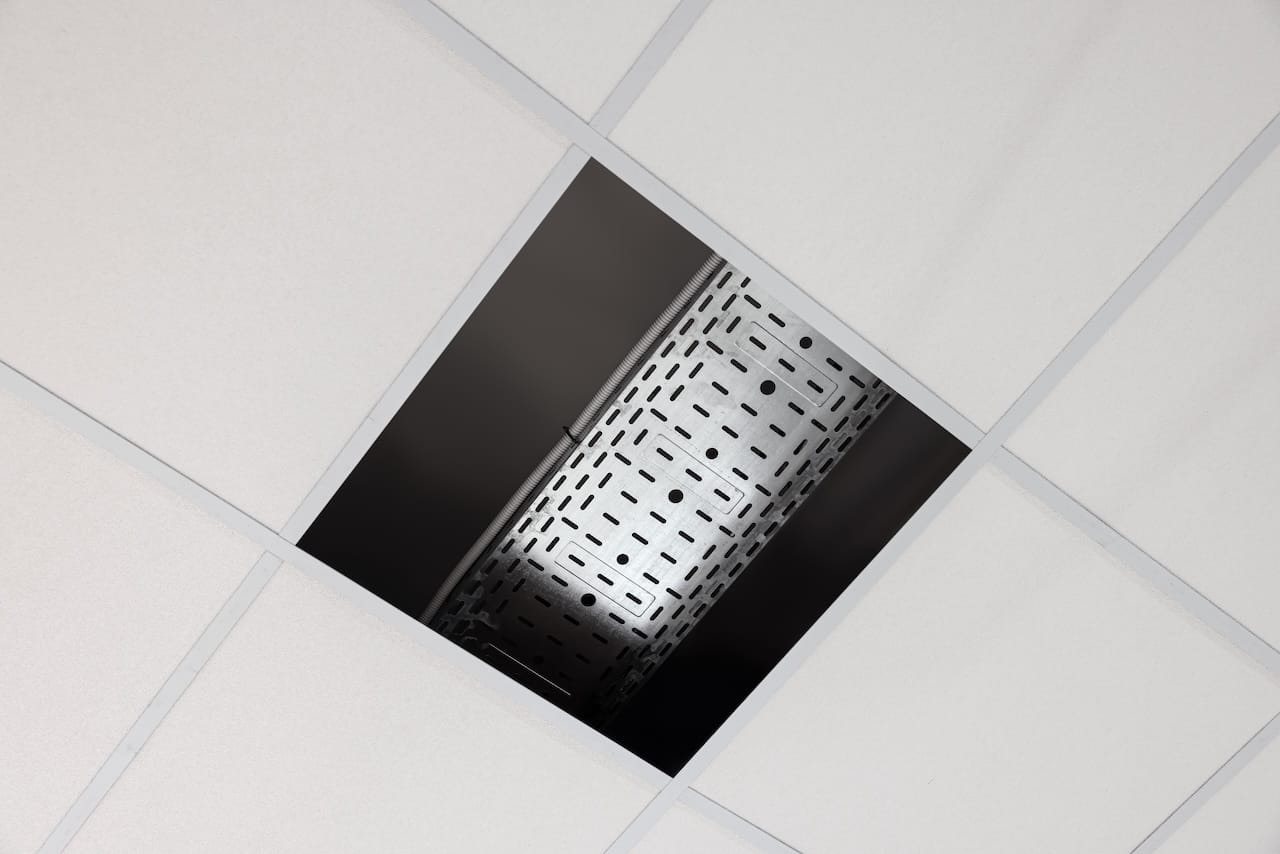
In theory, extending partitions all the way to the deck can limit sound transfer. In practice, this approach is rarely perfect. Pipes, conduits, cable trays, and ducts often penetrate the barrier dozens of times. Each penetration weakens the isolation, making the barrier far less effective than expected.
For this reason, ceiling absorption and mechanical noise control often play a larger role in exposed ceiling acoustics.
Tools
Typical installation tools include:
- Rotary or hammer drill and impact driver
- Aviation snips or tin snips for sheet materials
- Utility knife with hook blades
- Oscillating multi-tool for precision cuts
- Laser level, stud finder, and measuring tape
- Rivet gun and anchors
- Safety PPE such as respirators, gloves, and safety glasses
Having the right tools ensures materials can be installed accurately and safely.

Soundproofing Drop-Tile Ceilings in Suspended Grids
Suspended ceiling systems offer several opportunities for acoustic improvement. Because tiles are removable, treatments can often be added without major structural changes.
However, installers should confirm the ceiling grid and hanger wires can support any added mass. Even one pound per square foot can accumulate quickly across large ceiling areas.
Step 1 – Improve Absorption First (NRC)
The first step is usually upgrading the ceiling itself.
Replacing low-absorption tiles with high-performance options improves reverb control and reduces overall noise levels. In busy environments such as classrooms or open offices, tiles with an NRC of 0.80 or higher are often desirable.
If tile replacement isn’t feasible, fiberglass backers placed above existing tiles can increase absorption.
Step 2 – Block Flanking Through the Plenum
Once absorption improves, attention can shift to sound traveling above partitions.
In theory, installing plenum barriers or attempting a deck-to-deck partition extension can close the “shortcut” path that sound uses to bypass walls. However, real-world ceilings often contain extensive mechanical services. Penetrations for ductwork, wiring, and piping can quickly compromise the barrier.
A more practical approach is to manage sound pathways through duct systems. Lined ducts, flexible connectors, or a return air transfer silencer can allow airflow while reducing the amount of sound traveling between rooms.
Step 3 – Seal Penetrations & Fixtures
Ceiling penetrations are another common sound leak.
Different penetrations require different treatments. Sprinkler heads and small cable openings can typically be sealed using fire-rated acoustic sealant or approved firestop materials.
Larger openings – such as recessed lights or ceiling speakers – require more substantial treatment. These fixtures should be backed with sealed plenum boxes constructed from layered drywall or MDF assemblies. Adding damping compounds between layers helps block sound transmission.
Ideally, the boxes should also be decoupled from joists using isolation clips and fully sealed to the back of the drywall. Even small gaps around power cables should be sealed to prevent flanking paths.
Step 4 – Address HVAC Noise
Mechanical noise can easily undermine otherwise well-designed acoustic spaces.
Several simple steps help reduce this issue:
- Add an HVAC duct liner to absorb sound within ducts
- Use flexible connectors to reduce vibration transfer
- Install vibration isolation hangers for noisy equipment
- Introduce bends in duct runs so sound cannot travel in a straight path
Evan adding two 90-degree turns to a duct run can significantly reduce sound transmission between rooms.
Soundproofing Open Plenums (Exposed Ceilings)
When ceilings are left open, the absence of a tile grid eliminates one of the most convenient locations for acoustic materials. As a result, exposed structures often require alternative approaches.
Control Reverberation
Open ceilings tend to produce long reverberation times because hard structural surfaces reflect sound.
Solutions typically focus on adding absorption directly to structural surfaces. Examples include:
- Acoustic panels mounted to the deck or walls
- Baffles or banners suspended below structure
- Spray-applied absorptive materials
The goal is to meet reasonable RT60 targets for offices, improving speech clarity and overall comfort.
This type of acoustic treatment is especially important in environments like call centers, collaborative workspaces, or classrooms where speech intelligibility matters.
Manage Sound Transfer Paths
Sound can still travel between rooms through the open plenum. Attempting full deck-level barriers is sometimes discussed, but the number of penetrations required for services often limits their effectiveness.
Instead, controlling sound pathways through mechanical systems becomes more practical.
Acoustically lined ductwork, plenum wrap, and lagging around pipes can help limit noise traveling through building services. In some cases, installing a return air transfer silencer can preserve ventilation while improving privacy.
These solutions often deliver more reliable results than attempting to create a perfectly sealed barrier in a crowded plenum space.
Balance Masking and Treatment
Another factor in open ceilings is the relationship between sound masking vs ceiling treatment.
Masking systems introduce low-level background sound to make conversations less intelligible at a distance. However, masking works best when paired with a proper acoustic absorption. Without adequate absorption, the masking noise itself can become distracting.
Combining masking with thoughtful ceiling treatments typically produces the most balanced result.
Measuring Success with Acoustical Surfaces
After installation, verifying performance helps confirm that acoustic improvements are delivering the expected benefits.
Several simple methods can be used:
- Spot measurements of RT60 to confirm reverberation control
- Speech transmission proxies such as STI or SII
- Background noise floor readings
- Occupant feedback surveys
Together, these measurements provide a practical view of how well the acoustic strategy is working in real conditions.
Every building presents unique acoustic challenges, especially when ceiling systems play a major role in sound transmission. With the right materials and installation strategies, both suspended ceilings and exposed plenums can be improved significantly.
If you’re evaluating commercial ceiling soundproofing options or planning upgrades to an existing space, our team at Acoustical Surfaces can help you identify practical solutions tailored to your building.
Contact us to discuss your project and explore the most effective ceiling acoustics strategies for your environment.