

 Acoustical Ceiling Tiles
Coat of Silence™ Sound Reducing Paint

Please Note: Due to a raw material shortage, this product is currently unavailable until further notice. We apologize for the inconvenience and are actively working to resolve the issue. At this time, we do not have an estimated availability date. This page will be updated as soon as additional information becomes available.
Spray-On Sound Reducing Coating
Introducing Coat of Silence – the easy to use, spray on sound deadening coating for all your interior sound reduction projects.
- As Simple as Applying Paint
- One Person Process
- Consistency in Performance
- High Degree of Sound Reduction
- Reduce Noise Transmission
- Cost Effective
- Mold, Mildew and Water-Resistant
- Class A Fire Retardant
Product Testing & Information
 Product TAG
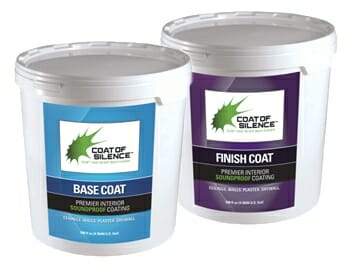
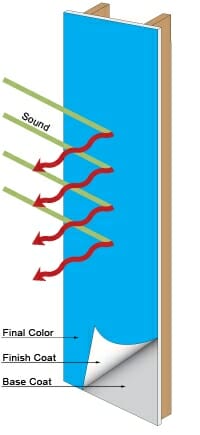
Coat of Silence™ soundproof paint is applied using a 2-step application process of two layers of “resilient” base coat followed by a “mass building” finish coat. By increasing mass, Coat of Silence sound absorption paint reduces sound transmission through walls and ceilings. The Coat of Silence™ base coat layer retains resiliency over time and the durable finish coat is ready for the paint or wall covering of your choice.
Coat of Silence™ soundproof paint brings a 2-step system that can be sprayed onto any existing surface or with new construction. This sound absorption paint is a new proven soundproofing solution that keeps the noise out as well as the cost and labor down. Applications include hospitals, hotels, schools, condos, apartments, home media rooms, offices, retail centers, construction, and many more.
- Read More: Frequently Asked Questions about Coat of Silence™
- See Also: Paintable Acoustic Fiberglass Panels
Product Specs
STC RATING
Sound deadening spray can increase room/partition by 3-7 points depending on room construction and application methods.
COLOR
White
DENSITY
Base Coat – 9.45 ± 0.2 lbs/gal
Finish Coat – 9.85 ± 0.2 lbs/gal
DRY CONTENT
Base Coat TNV – 64.28% (62 ± 2)
Finish Coat TNV: – 61.61% (62 ± 2)
CLEANING & DILUTION
Water
APPLICATION
Sprayed
APPLY TEMPERATURE
Between 50°F and 90°F
SPRAY NOZZLE SPECIFICATIONS
A 317 tip is recommended
COVERAGE
Base Coat – One gallon covers approximately 100 sq ft at two coats
Finish Coat – One gallon covers approximately 100 sq ft at two coats
Example: A job requiring 500 sq ft of coverage would require 10 gallons of product; 5 Base Coat and 5 Finish Coat.
LENGTH OF STORAGE
Original, unopened containers may be stored for up to 12 months. Open, unused material should be disposed of after a 6-month period.
FLAMMABILITY
Flame Spread: 15; Smoke Developed: 10
Easy To Use
The Coat of Silence sound reduction system is applied using a 2-step application process of 2 layers of “resilient” Base Coat followed by 2 layers of “mass building” Finish Coat to reach an ideal thickness of 25-35 mils. We recommend only those with commercial/airless spray application experience, or painting/coatings professional, attempt to apply this product.
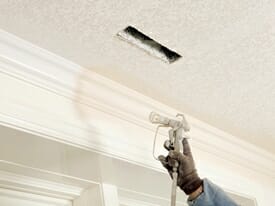
Step One
After priming your surface, two coats of Base Coat sound insulation spray is recommended for best sound reduction results.
- Because of the sound dampening paint’s thickness, stir thoroughly with a drill or paddle.
- Because a membrane is created, spray an ample coat without running.
- To effectively achieve thickness of product, do a vertical and horizontal pass for each layer.
- For best performance, wait 20-40 minutes between layers, or until product is dry.
Step Two
Two coats of this sound-reducing paint’s Finish Coat are recommended for best performance.
It can be painted over by any kind of paint, including latex & enamel.
- Because of product thickness, stir thoroughly with a drill or paddle.
- Apply an even coat to ensure a consistent finished surface.
- To effectively achieve thickness of product, do a vertical and horizontal pass for each layer.
- For best performance, wait 20-40 minutes between layers, or until product is dry.
Application
An airless sprayer with a 317 tip and 1,800 to 2,400 psi is recommended. Be sure to clean the sprayer using soap and water within 30 minutes (after last use) or the material will begin to set inside the sprayer.
Please note: the dampening ability of the material is not affected by soundproofing paint application method.
Clean Up
Clean up can be done with soap and warm water.
Significant Sound Reduction
With the Coat of Silence 2-coat process, mid-range sounds become contained. Common noise is greatly reduced. We have reached an industry high – even the test labs were a buzz. To date, no other sound reduction solution can deliver with the consistency of Coat of Silence. Manufactured at the same high quality as major paint manufacturers.
Our patent-pending Coat of Silence resilient layer (Base Coat) is scientifically formulated to increase the STC rating of a room/partition by 3-7 points depending on the room construction and application methods. The Base Coat forms nano membranes that create sound reducing and sound deflecting barriers. Our Finish Coat has the same sound deflecting formula to complete the sound reduction system.
No other sound reduction process offers such results with so little work. It’s tested in accordance with ASTM E90-09 and E413-04 as well as UL tested. Underwriter Laboratory has been testing products and helping to define standards for more than 75 years and they evaluate more than 19,000 types of products, components, materials and systems a year. With these testing standards, you know Coat of Silence silences the competition, as well as the room.
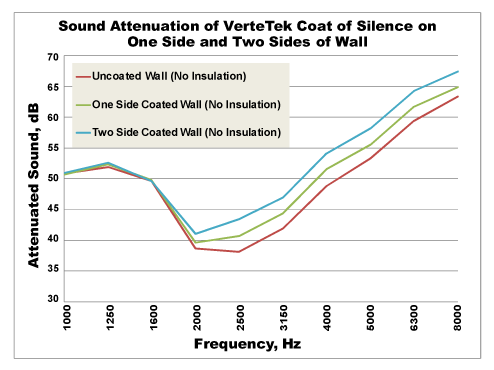
| Coat of Silence – Improvement of One Side Coated Wall to Attenuate Sound | |||||
|---|---|---|---|---|---|
| Frequency (Hz) | Uncoated Wall | One Side Coated Wall | Improvement of | Two Side Coated Wall | Improvement of |
| 125 | 20.6 | 23.3 | 2.7 | 23.4 | 2.8 |
| 3150 | 38.1 | 40.7 | 2.6 | 43.4 | 5.3 |
| 4000 | 41.9 | 44.4 | 2.5 | 46.9 | 5.0 |
| 5000 | 48.8 | 51.5 | 2.7 | 54.1 | 5.3 |
| 6300 | 53.3 | 55.5 | 2.2 | 58.2 | 4.9 |
| 5000 | 59.4 | 61.7 | 2.3 | 64.3 | 4.9 |
Coat of Silence Compared to Other Acoustical Treatments
Coat of Silence is often considered an alternative to installing acoustic panels or other sound-absorbing materials when seeking sound reduction solutions. While it may not provide the exact same level of performance as dedicated acoustic panels, it offers several advantages that make it an attractive option.
Easy Application
Coat of Silence is applied like paint, making it a user-friendly option that doesn’t require specialized skills or equipment. This ease of application allows for a more straightforward and convenient installation process compared to installing acoustic panels or other sound-absorbing materials, which may involve more complex mounting systems or professional assistance.
Versatility
Coat of Silence can be applied to various interior surfaces, including walls, ceilings, drywall, and plaster. This versatility allows for broader coverage and potential sound reduction across multiple areas of a room or space.
Effective Sound Reduction
While the exact capabilities of Coat of Silence may vary depending on factors such as the specific product used and application method, it is designed to provide effective sound reduction. It can help reduce sound buildup caused by hard and/or porous surfaces, which can contribute to noise transmission and reverberation within a space. Although it may not match the performance of dedicated acoustic panels, Coat of Silence can still make a noticeable difference in reducing sound levels and improving the acoustic environment.
What is Coat of Silence?
Coat of Silence is a scientifically proven 2-step sound reduction solution for use on interior walls, ceilings, drywall and plaster. It’s the perfect choice for those looking for an effective, easy to apply coating for interior sound reduction projects. It goes on like paint and doesn’t require special skills to apply. In fact, it only takes on person with painting skills to perform the easy 2-step process.
What is Transmission Loss?
Transmission Loss is a measurement of a partition’s ability to block sound at a given frequency, or the number of decibels that sound of a given frequency is reduced in passing through a partition. Measuring Transmission Loss over a range of 16 different frequencies between 125-4000 Hz is the basis for determining a partition’s Sound Transmission Class.
What is a STC Rating?
Technically speaking, STC stands for Sound Transmission Class, which is the measurement used to calculate the effectiveness of sound reduction materials in reducing sound transmission between rooms. It is a single-number rating of a material’s or an assembly’s ability to resist airborne sound transfer at the frequencies 125-4000 Hz. Simply put, it measures how much sound a wall, for instance, will block from getting through to the other side. Generally speaking, the higher the STC rating, the more effective a material is at blocking sound at the most common frequencies. STC is highly dependent on the construction of the partition. A partition’s STC can be increased by:
- Adding mass
- Increasing or adding air space
- Adding absorptive material within the partition
A partition is given an STC rating by measuring its transmission loss over a range of 16 different frequencies between 125-4000 Hz. This range is consistent with the frequency range of speech. The STC rating does not assess the low frequency sound transfer. Special consideration must be given to spaces where the noise transfer concern is other than speech, such as mechanical equipment or music. Even with a high STC rating, any penetration, air-gap, or “flanking” path can seriously degrade the isolation quality of a wall. Flanking paths are the means for sound transfer from one space to another other than through the wall. Sound can flank over, under, or around a wall. Sound can also travel through common ductwork, plumbing or corridors. Noise will travel between spaces at the weakest points. There is no reason to spend money or effort to improve the walls until all the weak points are controlled. The STC rating is based on performance with frequencies from 125 to 4000 Hertz (the speech frequencies). The rating provides no evaluation of the barrier’s ability to block low frequency noise, such as the bass in music or the noise of some mechanical equipment. The STC rating is a lab test that does not take into consideration weak points, penetrations, or flanking paths. The field test, however, does evaluate the entire assembly and includes all sound paths.
What is a Recommended STC Rating?
In general, loud speech can be understood fairly well through an STC 30 wall but should not be audible through an STC 60 wall. An STC of 50 is a common building standard and blocks approximately 50 dB from transmitting through the partition. However, occupants could still be subject to awareness, if not understanding, of loud speech. Constructions with a higher STC (as much as 10dB better – STC 60) should be specified in sensitive areas where sound transmission is a concern. The Uniform Building Code (UBC) contains requirements for sound isolation for dwelling units in Group-R occupancies (including hotels, motels, apartments, condominiums, monasteries and convents). UBC requirements for walls: STC rating of 50 (if tested in a laboratory) or 45 (if tested in the field*). UBC requirements for floor/ceiling assemblies: STC ratings of 50 (if tested in a laboratory) or 45 (if tested in the field*).
*The field test evaluates the dwelling’s actual construction and includes all sound paths. An assembly rated at STC 50 will satisfy the building code requirement. However, as mentioned above, occupants could still be subject to awareness, if not understanding, of loud speech. Therefore, it is typically argued that luxury accommodations require a more stringent design goal.
What is Sound Blocking?
Sound blocking prevents sound from entering or leaving a room. Sound blocking is measured by STC ratings. The higher a product’s STC rating is, the more effective the product will be.
How Does Coat of Silence Work?
Our Coat Of Silence resilient layer (Base Coat) is scientifically formulated to increase the STC rating of a room/partition by 3-7 points depending on the room construction and application methods. This high performance rating has never been accomplished in a coating before. The SBR (styrenated buradiene rubber) forms an actual rubber membrane as it dries/cures along with a heavy bodied water based latex and sound absorbing fillers that deflect sound and keep it contained. Our Finish Coat has the same sound deflecting formula with a hardening agent to make a complete sound reduction system. The Finish Coat can be painted over with any type of paint and will satisfy any decorating concerns.
How Do I Apply Coat of Silence?
Coat of Silence goes on like paint and doesn’t require special skills to apply. In fact, it only takes one person with painting skills to perform the easy 2-step process. Because of product thickness, stir thoroughly for 2 to 5 minutes with drill or paddle. For best sound reduction results, two coats of our Base Coat is recommended. Simply apply by sprayer, let dry to touch, then apply the second Base Coat. To complete the 2-step process, use Coat of Silence Finish Coat, which can be painted over with any type of paint.
How do Paintable Acoustical Wall Panels work?
Paintable Acoustical Wall Panels absorb sound waves that reflect off hard surfaces. Their fiberglass core captures sound energy, helping reduce echo and reverberation in spaces like conference rooms, offices, churches, studios, auditoriums, and entryways.
What do I Have to do for Surface Preparation?
Areas to be covered must be thoroughly cleaned and free of dust, dirt, grease and wax.
How Long Should I Wait In Between Coats?
Coat of Silence dries to the touch in approximately 20 minutes. Please note, low temperatures or higher humidity will lengthen dry times. Once it is dry to the touch, you may begin with the next coat.
Can It Be Painted Over?
Yes. Coat of Silence Finish Coat can be painted over with any type of paint including latex or enamel.
Is Coat of Silence Toxic?
No. Coat of Silence is water based and non-toxic. It is also mold, mildew and water-resistant. As with all products, paints, coatings, etc., you should use proper precautions and read the MSDS before using Coat of Silence.
Is Coat of Silencer a Fire Hazard?
No. Coat of Silence has been fire tested and is not a fire hazard.