
Dealing With A Noisy Hair Salon
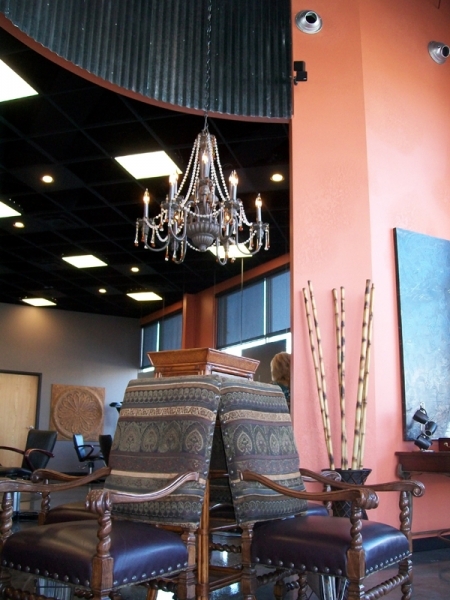
Ok, I’ll admit it. I get my hair cut in a salon – but please don’t tell any of my buddies. I only go there because I’ve known the woman for years and she gives me a good deal.
Salons all seem to have similar characteristics. They contain hard floors that can be easily cleaned: concrete, tile, wood, etc. They usually have drywall and most spaces, at least newer ones looking to be hip, have a metal roof deck with exposed services (duct work, wires, pipes, etc). It looks great, but it causes a major sound problem. Especially with chatty employees and talkative clients.
I recently received an inquiry for a similar situation with a major sound problem. I would highly suggest reading my article on basic sound properties if this is confusing at all.



The Situation
The room in question is ~30′ x 60′ x 16′ tall. From an acoustical standpoint, I would recommend between 800 and 900 square feet of acoustical paneling spaced evenly throughout the space. How did I come by this conclusion?
You don’t want to completely get rid of all of the noise, but “take the edge off” a bit. So, for that, the equation I have used very successfully in the past is as follows:
- Cubic Volume x 3% = Square Footage Installed
So, for the room above, we get:
- 30′ x 60′ x 16′ = 28,800 (Cubic Volume)
- 28,800 x 0.03 = 864 Square Feet of Acoustical Paneling
I rounded up in this case because there doesn’t look to be ANY absorptive surfaces in the room as it stands.
The Solution
There are two options that come to mind for this room: Recycled Cotton Panels and Fabric-Wrapped Fiberglass Panels.
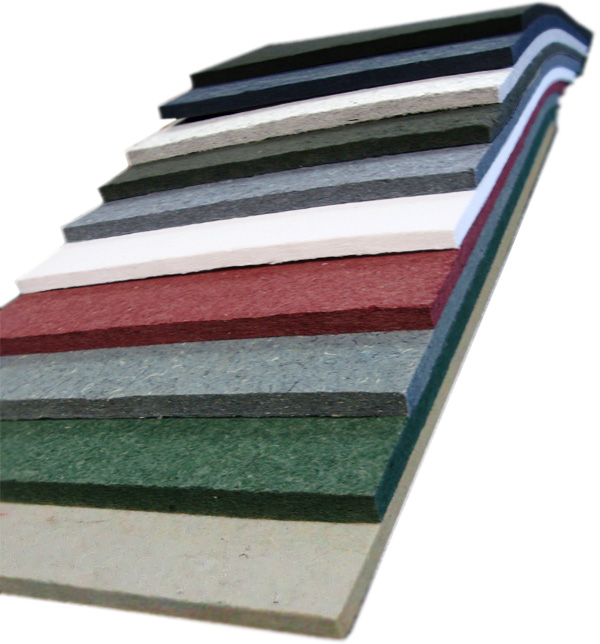 The first product that came to mind would be a recycled cotton panel. Since the metal roof deck is exposed, you can get the cotton to blend in to the ceiling by gluing it directly to the under side of the corrugated metal deck. It will not be as decorative, or “finished looking” as some other products available, but by choosing the right color they should be mostly unseen. Only an acoustics geek, like myself, would notice them. I highly doubt that my wife would ever notice them. The great thing about these panels are not only that they are environmentally friendly, being made from recycled cotton, but they are also cost effective and easy to ship.
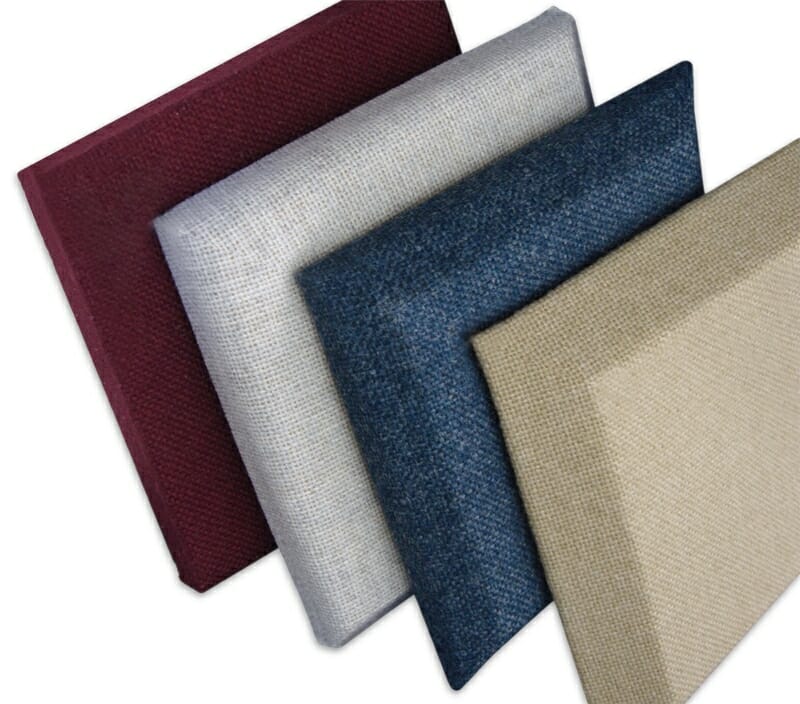 Alright, so if that doesn’t sound interesting enough, the next product I thought of would be a fabric-wrapped fiberglass panel. The name says it all, it is a board of fiberglass that is cut to size and wrapped with your choice of decorative fabric. The performance of these are going to be about the same as the cotton panels, but you have more freedom of choice when it comes to the size, shape, and color. These will be a bit more difficult to install as they are heavier and will require mechanical clips to hold them up. These are also going to be more pricey than the cotton panels as they are a custom product. Because they are a lot heavier and more fragile, they will also cost more to ship as they are almost always put onto pallets, crated, and shipped on a semi-truck.
These are only a couple of suggestions, but each situation is going to be different. What do you think? Do you have a better/different suggestion for a similar situation?
2 Comments
Dana Downs
Does insulation on the back of canvases work? Need some sound/echo absorption.
Ted W
Dana,
Thank you for the comment! The answer to your question is going to be variable and really depend on the canvas and what has been applied to it.
Canvas, naturally speaking, is not a very good fabric to use in front of acoustical panels because it is relatively dense and not very porous. Further, if the canvas has been painted with quite a few layers of paint and all of the holes and gaps in the canvas have been completely clogged and covered.
It is imprtant to keep in mind that sound travels through air, and if air can flow through the canvas, so can the sound – and the idea is to get the sound to the absorptive material on the back side.
When we wrap panels or provide stretch-fabric systems, we use fabric that is very porous. So much so that you can breathe through the fabric quite easily. I often suggest to people to hold the fabric up to the light and determine how much light can pass through the fabric. For instance, burlap would be a GREAT fabric to use, where as denim would be not nearly as good.
I hope this helps.
thank you,
Ted